



Leadership and Employee Wellbeing Are Connected: Here’s How
Amid today’s persistent stress and disruption, organizations can’t rely on individual self-care alone to prevent burnout. Resilience is essential, but it’s only one thread in a larger cultural fabric.
Achieving lasting wellbeing requires leaders to prioritize collective connection and a deep sense of belonging. Our research shows this shift is vital for geographically dispersed teams, where meaningful relationships don’t happen by accident — they are built by design.
Employee Wellbeing Requires Leadership
First, why does wellbeing matter, particularly in the workplace?
When employees have a sense of wellbeing, they’re more engaged and creative. They also have higher job satisfaction and productivity levels, studies show.
And the importance of wellbeing and leadership is clear: “As a leader, it’s your duty to take care of others and to create an environment where others can be well,” says Dr. Paige Graham, who’s been an executive coach and facilitator for more than 20 years and is leading our work to create client solutions for leadership and wellbeing.
“I like to think about wellbeing as feeling good and functioning well, both individually and within a community,” Graham notes.
Workforce volatility has fundamentally redefined the social contract. Today’s talent has moved beyond the live-to-work mindset, prioritizing a sustainable integration of career and life. They’re looking for more than a paycheck; they expect meaningful work within a culture that invests in collective wellbeing.
Wellbeing Leadership: 6 Components
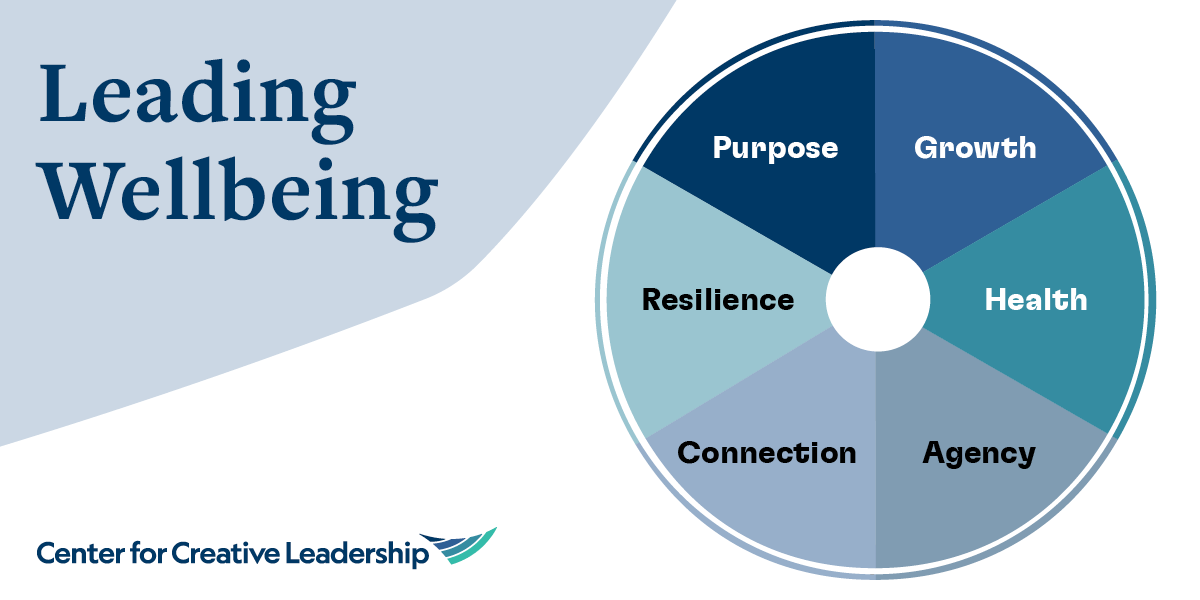
The 6 Keys of Wellbeing
At CCL, we focus on 6 components of leading with wellbeing, so that organizations can enact deliberate practices that help their people enhance their own leadership and wellbeing — as well as that of their colleagues and direct reports. Here are the 6 keys to wellbeing:
When leaders focus on these 6 things, they’re prioritizing wellbeing as a source of collective energy.
This vitality is contagious — it impacts their teams and powers the culture of the wider organization. As this shared energy around employee wellbeing is supported and rewarded, new mindsets and practices take root, creating a sustainable surge of momentum across the enterprise.
1. Purpose.
When employees feel that their work has intrinsic value and meaning — and when they can connect their day-to-day tasks to the organization’s mission — they’re more likely to feel a sense of purpose.
Achieving a sense of purpose starts with recognition. “It’s helpful to recognize the parts of our jobs that bring us energy and are aligned to what we believe is meaningful,” says Graham. Though helpful for everyone, value alignment is especially key for younger generations in the workforce.
- TIP: Leaders can support employee wellbeing and facilitate this connection with a focus on purpose in leadership. Encourage your people to think about what makes work meaningful for them. During meetings, check in on individuals, and not just on their work tasks. You can simply ask, How are things going? What brought you energy last week? What’s creating frustration for you? And then actively listen to their experiences, and respond with empathy and compassionate leadership. Resist the urge to judge or become defensive. Remember that the goal is not to “fix” every issue, but to hear what’s going on, and provide support.
2. Growth.
Humans crave challenges, so employee wellbeing is enhanced when people feel they’re growing and learning. When a learning culture is prioritized and a growth mindset is valued across an organization, leaders accept mistakes as opportunities to reflect on what was learned. As a result, people feel free to be more innovative and creative, because they’re not afraid to take risks.
- TIP: Leaders should reflect on how they respond to new ideas and use meetings as an opportunity to celebrate both wins and losses, creating space for people to share what they’re learning from what went wrong. This works best when managers and supervisors make an intentional effort to build a psychologically safe workplace so that team members feel comfortable revealing mistakes and discussing lessons learned.
3. Health.
Health is an essential component of wellness, as healthy minds and bodies are shown to enhance reasoning, problem solving, learning, and creativity.
“There’s only so much the human brain can handle,” says Graham. “If you work constantly without resting or incorporating movement into your day, you won’t be able to handle the bigger cognitive challenges. Your memory will suffer and you won’t be as creative.”
There’s a connection between good health and leadership: Optimal health and leadership effectiveness both start with foundational practices, such as movement, nutritious foods that fuel your brain, and a good night’s sleep — all of which help us regulate our emotions and process the events of the previous day.
- TIP: Leaders’ actions cement the culture. If you make time for wellness and model a focus on your own health as one of the keys to wellbeing — unplugging and taking real vacations from work (and encouraging others to do so too); creating boundaries around how late you send emails; and taking intentional steps like scheduling “walk-and-talk” meetings to increase your movement throughout the day — these all send a strong message of support for employee wellbeing to your direct reports, who are watching and learning from your behavior.
4. Agency.
When employees perceive a sense of control, as opposed to feeling externally controlled, they tend to be more well. When they meet roadblocks, people with a sense of agency are also more persistent in achieving their goals and in living with intention at work and at home.
“Sometimes when we feel like we don’t have a say and things are happening to us — that we are just picking up the pieces — we feel very little control over our own actions and the consequences of those actions,” says Graham.
How can leaders give people a sense of agency? Start by understanding the connection between purpose, agency, and employee wellbeing.
- TIP: If you know what gives each of your team members a sense of purpose, you can provide options for incorporating more of those responsibilities into people’s jobs. Organizational leaders can also support employee wellbeing by giving their employees as much choice as possible in where and how they work. Flexibility in the workplace benefits organizations because it improves employee engagement, loyalty, and retention. People perform at higher levels when they have the agency to schedule their workdays and prioritize what’s important across their work and personal lives.
5. Connection.
Employee wellbeing also requires leaders intentionally helping people to connect with one another. That’s important because strong and healthy relationships lead to acceptance of others and a culture of respect.
Helping people connect can be easier said than done. “Leaders have to understand that people have different preferences for connecting with others,” says Graham. “Some people like to be really social, but that’s not right for everyone.”
At CCL and many other organizations, Employee Resource Groups (ERGs) give people an opportunity to connect with others across certain commonalities. Often these are unique groups of people who typically haven’t worked together but share common experiences and social identities.
“Whether we’re being supported, or we are supporting others, we come away with a great feeling of connection and belonging at work, which is an essential human need,” says Graham.
- TIP: For leaders and organizations as a whole, the goal is to foster employee wellbeing by creating a trusting environment where people feel comfortable to be themselves, share how they’re feeling, and know they will find support. Leaders can start with inclusive leadership practices.
6. Resilience.
Organizations benefit from having resilient employees because, in challenging organizational settings or during times of change, resilient people operate more effectively and productively.
Resilience and wellbeing aren’t the same thing. While resilience is needed during stress, uncertainty, and setbacks, wellbeing impacts us all the time.
When times are tough, resilience is the ability to bounce back. Not only are resilient people able to adapt in the face of adversity, but they also grow and feel prepared for their next hurdle.
- TIP: Graham recommends seizing the good times to develop resilience. “I like the idea of upping my game, even when things are going well,” she says. It’s worth the effort: Resilient people tend to have greater wellbeing, and greater wellbeing leads to higher resilience. Not sure where to start? Learn 8 practices of resilient leadership.
Evidence That Development Strengthens Leadership & Employee Wellbeing Behaviors
We’ve designed 6 leadership development modules that mirror our wellbeing philosophy, giving organizations a scalable way to help their leaders learn and apply all 6 components. These modules can be embedded into any experience, with options to include one, several, or all of them.
We’re a research-driven organization, and we’ve put these modules to the test. Our goal was to find out: Do they create measurable changes in employee wellbeing behaviors? Does the organizational context shape the degree of change?
We partnered with a global retail organization that implemented 4 of these modules across multiple leadership development programs spanning 3 regions and 3 leader levels. Participants completed a pre- and post-program survey assessing how often they engaged in wellbeing behaviors aligned with the 6 components, as well as their perceptions of their organization’s wellbeing culture.
The findings paint a compelling picture of meaningful change. Here are 3 key takeaways:
1. Leadership development programs do change wellbeing behaviors.
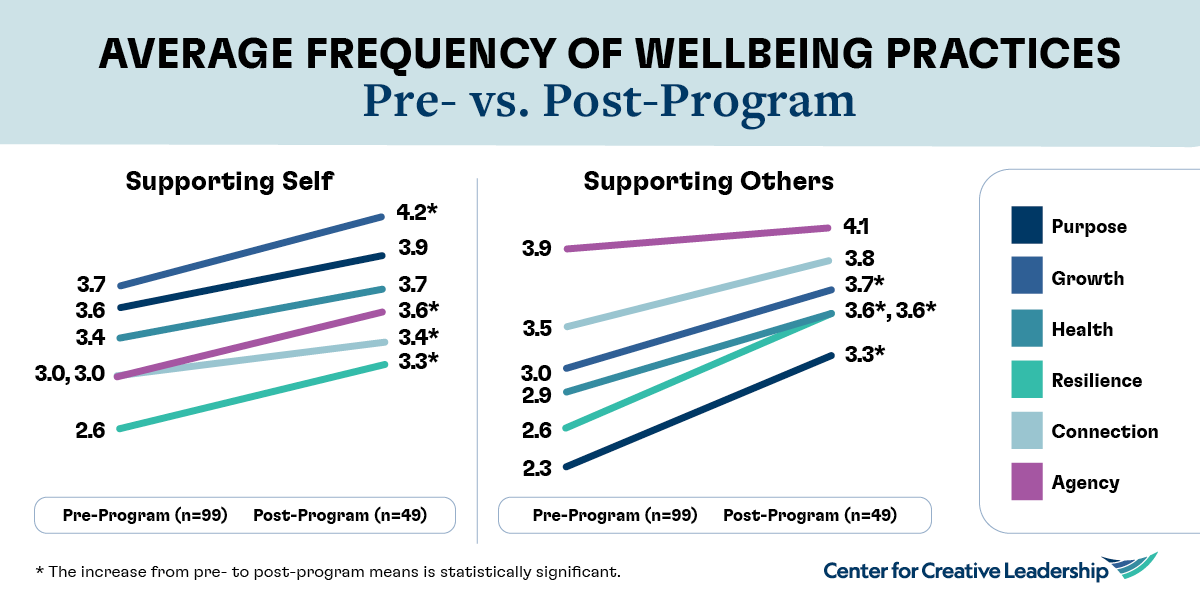
The programs led to statistically significant increases in how often participants engaged in growth, resilience, connection, and agency behaviors that support their own wellbeing, as well as purpose, growth, health, and resilience behaviors that support the wellbeing of others. Participants’ descriptions of these shifts reflected a move toward practical, day‑to‑day habits such as stress management, recovery, collaboration, and structured development.
One participant noted: “(I) look for more informal and formal spaces to give more purpose to the day-to-day tasks of both the team and colleagues.”
2. Room for growth leads to greater improvement.
The greatest improvement came from participants in the region with the lowest baseline wellbeing scores. This pattern highlights how training programs can be especially impactful in contexts where leadership and employee wellbeing behaviors are less established.
3. Organizational context accelerates change.
Certain organizational factors accelerated how quickly participants adopted new wellbeing behaviors. These include:
- Emphasizing wellbeing in organizational mission, vision, and values
- Leaders visibly modeling wellbeing behaviors
- Facilitating opportunities for wellbeing-focused conversations
- Cultivating a sense of equity
- Creating avenues for connection
In contrast, formal policies alone didn’t act as strong accelerators, underscoring the greater influence of cultural and relational elements over written guidelines.
Better Leaders Focus on Their Own & Their Employees’ Wellbeing
It’s important to note that employee wellbeing isn’t one size fits all. The keys to wellbeing may be slightly different from one person to the next. Team members may prefer to move or rest a bit differently or grow, share, connect, and be challenged in different ways.
That said, leaders being intentional about any of these things will result in increased employee wellbeing — for both individual managers and their teams.
Since the pandemic, there have been calls to stop framing wellness programs around self-care and instead focus on wellbeing for all, and it makes sense: If an organization’s leadership doesn’t promote wellbeing for the collective, the enterprise will never be as strong or productive as it could be.
At CCL, we believe in cultivating organizational cultures that truly support leadership on employee wellbeing — ensuring that people are better than just okay. We’ve created a downloadable collection of leadership resources on compassion, wellbeing, and belonging with actionable tips gleaned from our research.
When leaders focus on wellbeing and create space to care for themselves and others, they become more effective — as individuals, on their teams, within their organizations, and even impacting their entire communities.
Download Our Conversation Guide on Employee Wellbeing
Get our complimentary resource for (better) leadership today for help facilitating a productive conversation with your team on what leading with wellbeing looks like at your organization.
Ready to Take the Next Step?
Take a meaningful step toward increasing employee wellbeing by starting a conversation at your organization. Download our Conversation Guide for concrete tips on leading these discussions, and explore our wellbeing leadership training to equip your teams with the research-based skills needed to reduce burnout, fuel engagement, and build a high-performance culture across your organization.