



Disruption is the workplace norm, and it’s depleting the energy leaders need to grow themselves, their teams, and their organizations. As AI upends how we work, we can’t lose sight of the fact that human leaders remain the primary drivers of organizational success.
These leaders, though often drained of motivation by the weight of compounding obstacles, possess a distinctly human superpower. It’s a psychological fuel that quietly keeps our organizations running, even thriving. This resource is so innate to our daily experience that we hardly notice its presence until it disappears.
This is psychological capital, or PsyCap for short, a resource that leaders both require and produce, and an invaluable asset for helping leaders achieve all that is humanly possible.
PsyCap functions as fuel for the organizational machine, sustaining the leaders who keep its gears in sync and preventing the system from grinding to a halt.
What Is Psychological Capital?
Psychological capital is commonly defined as an individual’s positive psychological state, characterized by 4 core elements:
- Hope: A motivational state made up of agency (the willpower and energy to pursue important goals) and pathways (the ability to identify multiple routes to reach those goals even when obstacles arise)
- Self-Efficacy: A feeling of confidence that you can do the work required to succeed in your role
- Resilience: The capacity to bounce back from adversity and excel beyond it
- Optimism: A realistic expectation that you can succeed now and in the future
Studies find that employees with higher PsyCap are more committed, perform better, experience greater wellbeing, and are less likely to burn out.
Why Psychological Capital Is Essential for Leadership
Leaders with high PsyCap tend to exhibit stronger authentic leadership behaviors, such as self-awareness, relational transparency, and moral perspective, which are linked to higher levels of trust in their teams and better performance.
Leadership — which we define as a social process — depends on human energy, motivation, and psychological capacity. Sustaining it, especially amid complexity, demands something deeper than skills alone.
Leaders need mental resources to persist, adapt, and thrive. That’s where psychological capital comes in.
Researchers have studied PsyCap for decades, and findings suggest that psychological capital is a predictor of key indicators of organizational success, including performance, engagement, and retention. PsyCap captures the uniquely human strengths that enable leaders to navigate disruption and propel their organizations forward.
Importantly, PsyCap is not a fixed attribute. It’s developable. Through intentional experiences, coaching, and the right organizational support, leaders can build and sustain their psychological capital over time.
PsyCap also plays a critical role in driving long-term organizational outcomes and serves as a powerful indicator of the return on investment that leadership development provides.
The research we conducted with participants in our flagship Leadership Development Program (LDP)® reveals that PsyCap isn’t just a byproduct of development. It also explains why development works: Leaders who demonstrated higher levels of hope and optimism after completing the program also reported stronger goal attainment and team engagement.
This research suggests that increasing leaders’ psychological capital is a core part of what effective leadership development should do.
Boosting Psychological Capital Through Leadership Development
We’ve seen a consistent pattern over time: When leaders have the chance to step back, reflect, get real feedback, and try new approaches, they don’t just gain new skills. They obtain more of the inner fuel it takes to use those skills when things get hard. In other words, their PsyCap grows.
One of the simplest ways to see this is to look at psychological capital before a leadership program begins and after it ends. We’ve examined this for several of our custom programs for education leaders. Across these cohorts, we consistently see meaningful growth in PsyCap over time.
In a typical cohort, the percentage of leaders reporting “high PsyCap” rose from 36% before the program to 79% afterward.
This data tells us that psychological capital can grow through leadership development, and it leads to an interesting question: What’s happening inside the development experience that improves psychological capital?
When we zoom in, we can see that PsyCap doesn’t immediately improve. In fact, data collected during our LDP program shows that PsyCap can actually dip in the middle of the experience, often around the point where leaders receive challenging feedback via 360 results that increase their self-awareness. Then, after that, PsyCap rebounds and grows beyond where it started, as leaders learn new skills and strategies to address their challenges.
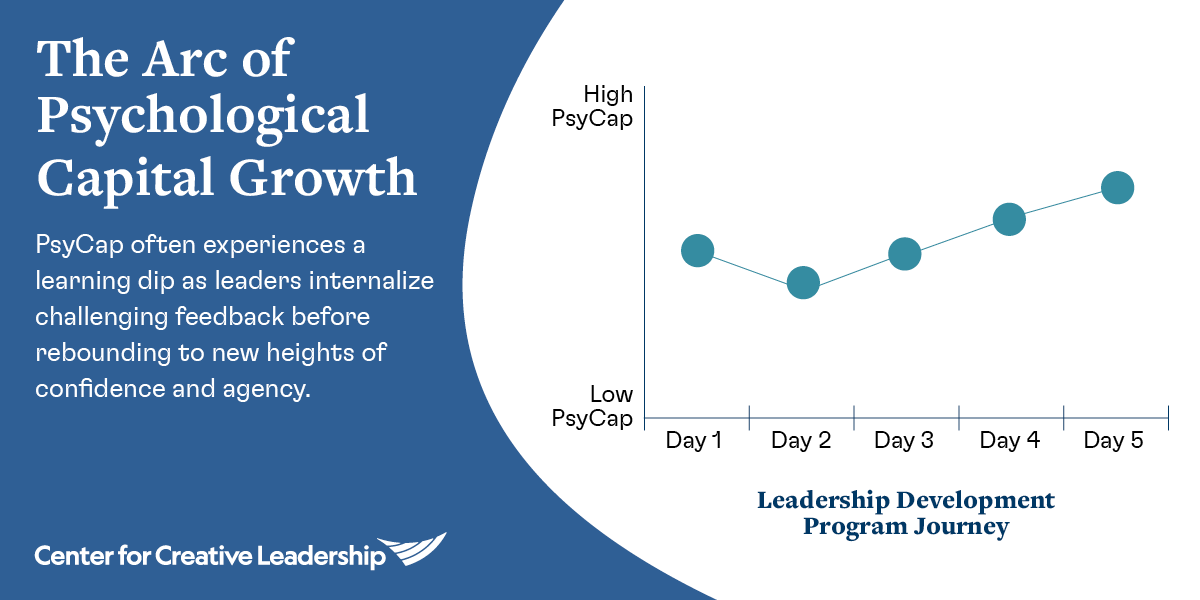
That dip is worth noting because it can be surprisingly normal: When someone is really taking in feedback, their confidence or optimism can wobble briefly before it strengthens.
The key is what happens next, and that’s where support matters.
Support for Leader PsyCap: The Unique Benefits of Coaching
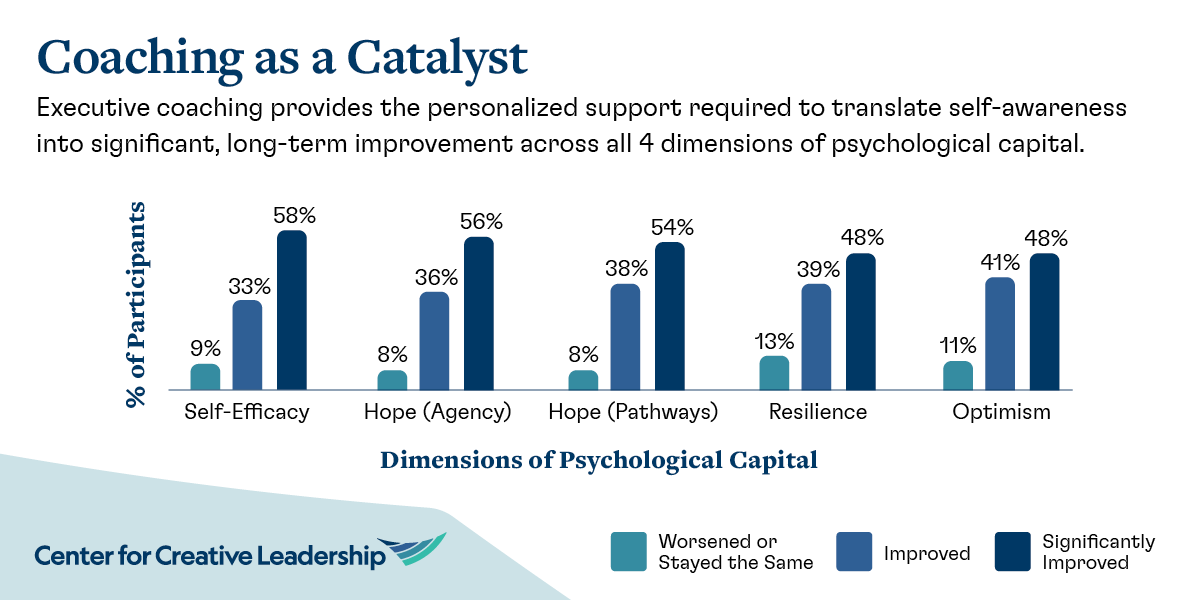
Coaching is one of the clearest ways leaders get intentional support. Not only that, but an evaluation we conducted found that coaching offers a personalized way for leaders to continue to address their challenges, even post-program, and to engage in goal-achieving behaviors that have a direct positive impact on psychological capital.
Even highly experienced leaders who engage in our executive coaching services report positive improvements in PsyCap. This fits with what coaching is built to do: Going beyond teaching new skills to build the self-awareness and internal work required for more effective leadership and replenishing the energy of leaders who practice those behaviors day after day.
Psychological Capital for Leaders: The Value of Bite-Sized Interventions
Psychological capital isn’t only impacted by lengthy, immersive in-person leadership development. We’re also seeing encouraging signs that it can be strengthened through short, targeted online leadership training experiences, especially when the learning is tied to a real work challenge.
We piloted a self-paced online course focused on building leaders’ PsyCap. Leaders who completed the course reported a meaningful and statistically detectable increase in psychological capital.
Average PsyCap increased by just under 1 point on a 1–5 scale (+0.74), and 86% of leaders in the online course said they experienced overall improvement. What’s especially helpful about this format is that it’s built around the leader’s key leadership challenge, so their personalized reflections and opportunities for practice remain anchored in a real-world challenge they’re trying to address at work.
Neurodiverse Leaders Experience PsyCap Differently
A growing body of evidence shows that organizations benefit from neurodiverse leadership teams and workforces. We’ve found that, when compared with neurotypical leaders, leaders who identify as neurodivergent (for example, with Attention Deficit Hyperactivity Disorder, or autistic) tend to report lower overall levels of PsyCap.
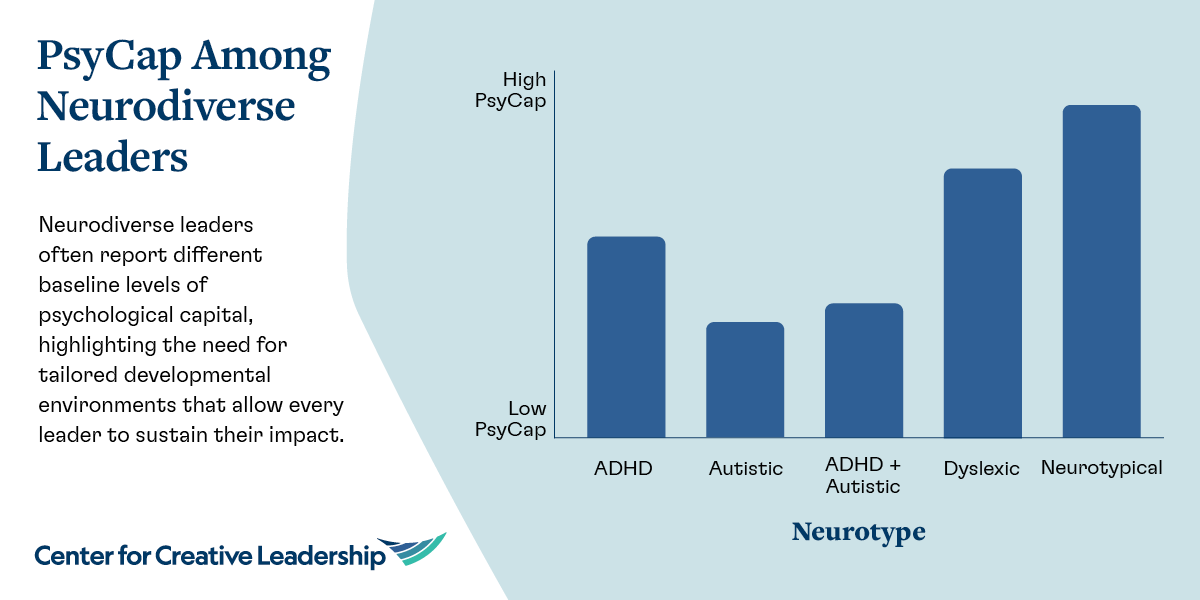
Importantly, these findings don’t suggest a lack of leadership potential. Rather, they underscore that leaders bring into their roles different strengths and needs related to their own psychological resources. For organizations, this reinforces the importance of building the necessary psychological conditions for all leaders to sustain their impact.
Ready to Take the Next Step?
We’re committed to continuing to explore the human side of leadership. Take the next step in building it — in yourself and in leaders across your organization. Our Leadership Development Program (LDP)® and executive coaching services are designed to grow the psychological capital and inner resources leaders need to perform at their best — even when things get hard.