



Building relationships as a leader has always been fundamental. But the conditions that once allowed those relationships to develop naturally no longer describe every organization.
Today’s leaders are more distributed, more AI-assisted, and more time-pressured. And yet the human connections that make leadership work — the trust, the shared understanding, the ability to move together under pressure — depend on the kind of slow, repeated, unscripted interactions that get optimized away in the rush to do more faster.
We define leadership as a social process, one that produces 3 essential outcomes across any group: direction, alignment, and commitment. Those outcomes emerge from the quality of relationships between the people responsible for producing them. Our research supports this: building collaborative relationships is among the top leadership competencies. They’re how leadership happens.
This is why relationship-building skills in the workplace deserve deliberate investment as a core leadership capability. The 6 traits that follow are learnable behaviors that determine whether leaders can create the leadership their organizations depend on.
Building Relationships as a Leader: Where To Start
6 Ways the Best Leaders Develop Relationship-Building Skills in the Workplace
1. They’re self-aware.
Boosting your self-awareness includes knowing your strengths and weaknesses, and the impact that your behavior has on others. Self-awareness is a foundational leadership capability, one that develops through honest reflection and a willingness to see yourself as others do.
In practice, this looks like a leader who recognizes that their tendency to move fast and decide quickly — a strength — can leave others feeling unheard or undervalued. That awareness creates a choice: not to change who you are, but to adjust how you show up in the moments that influence trust and connection. Leaders with strong relationship-building skills in the workplace aren’t always naturally gifted at it. They’re intentional about paying attention to their impact and doing something about what they find.
2. They delegate important tasks and decision-making.
Delegating helps to build trust on your team and develop the people around you. When leaders hold on to tasks they could hand off, they signal that they don’t trust others to deliver. When they delegate, they create the conditions for others to grow, take ownership, and build the confidence that comes from being trusted with responsibility.
Done well, delegation also requires leaders to give honest, consistent feedback and to recognize effort and progress along the way. That ongoing investment in others is itself a practice in building relationship skills, and it communicates that a leader is paying attention, that they care about development, and that the working relationship is built on more than task completion.
3. They have strong interpersonal skills.
They should be able to negotiate and handle work problems without alienating others. This requires leadership empathy and understanding others’ perspectives and needs. Leaders with honed relationship skills show kindness in the workplace and can develop a rapport with all kinds of people. Effective leaders are equally comfortable in a difficult conversation with a direct report, a cross-functional negotiation with a peer, or a high-stakes discussion with senior leadership, and people at every level feel it.
4. They lead through influence, not authority.
Strong leaders use listening and communication to involve others, build consensus, and influence decisions. We’ve identified 4 skills to influence others, and each one is fundamentally relational. This matters more as organizations grow more complex. Leaders today spend more than half their time influencing others without direct authority — across functions, geographies, and levels where they have no formal power to compel action. In those conditions, the quality of your relationships determines your ability to influence and lead.
5. They give constructive, effective feedback.
Giving effective feedback and avoiding common mistakes in giving feedback is one of the best ways to improve relationship building in leadership. Feedback lets people know how they’re doing, reinforces goals, and encourages strong effort. When giving feedback, make sure to focus on delivering a single message, being specific, and being sensitive. And remember to judge the behavior, not the person.
6. They manage their relational energy deliberately.
Effective leaders understand that every interaction either adds to or subtracts from the relational energy of the people around them. Our research across more than 34,000 relational ties found that a single consistently negative relationship cancels out the benefits of 4 positive ones.
Leaders with influential relationship-building skills in the workplace are aware of how their presence, attention, and communication patterns affect the people they lead. They protect time for connection, ask questions before giving answers, and treat the quality of their interactions as a strategic priority rather than a personality trait.
Why Building Relationship Skills at Work Matters
Technical expertise and strategic skills don’t always explain why some leaders succeed while others plateau. What separates them is often relational.
In describing or evaluating unsuccessful managers, their inability to develop and maintain relationships is listed among their biggest weakness and hindrance. Research has consistently found that leaders who lack strong relationship-management skills in the workplace and who have weak interpersonal skills are at high risk of derailing in their careers. No level of intelligence or experience reliably compensates for that gap.
Sure, some people will have an intrinsic ability to develop and maintain relationships. However, a successful executive — no matter how smart — can no longer hope their knowledge and experience will offset lukewarm people skills. Building relationships as a leader is critical in the workplace.
Without solid relationships, a leader can have a hard time bringing a team together and getting a project accomplished. Collaboration is only an effective workplace tool if the people who are collaborating can get along.
What were once called soft skills are proving to be among the hardest to develop and the most consequential to get right. The leaders who build strong relationships are the ones whose people choose to follow them, trust them with the hard conversations, and go beyond what’s required because the relationship makes it worth it.
Relationships, ultimately, are how leadership happens.
Why Relationship Skills Are Harder To Build Than Ever
Building relationship skills at work has always required intentional effort, but the conditions leaders face today make that effort more demanding and more consequential.
Digital tools and AI optimize for speed at the expense of depth. The informal exchanges that once built trust naturally have largely been replaced by agenda-driven interactions optimized for output. The tools driving individual performance are undermining the relational conditions that make collective performance possible.
At the same time, hybrid and distributed work has removed the proximity that once made relationship-building easier. Connection in virtual environments doesn’t disappear, but it doesn’t happen by accident. Leaders who want to build strong working relationships across distributed teams need to design for it deliberately.
The result: Building relationship skills as a leader remains consequential and requires more intentional effort to develop.
How To Build Your Relationship Skills
Fortunately, relationship skills are something that can be learned through leadership development.
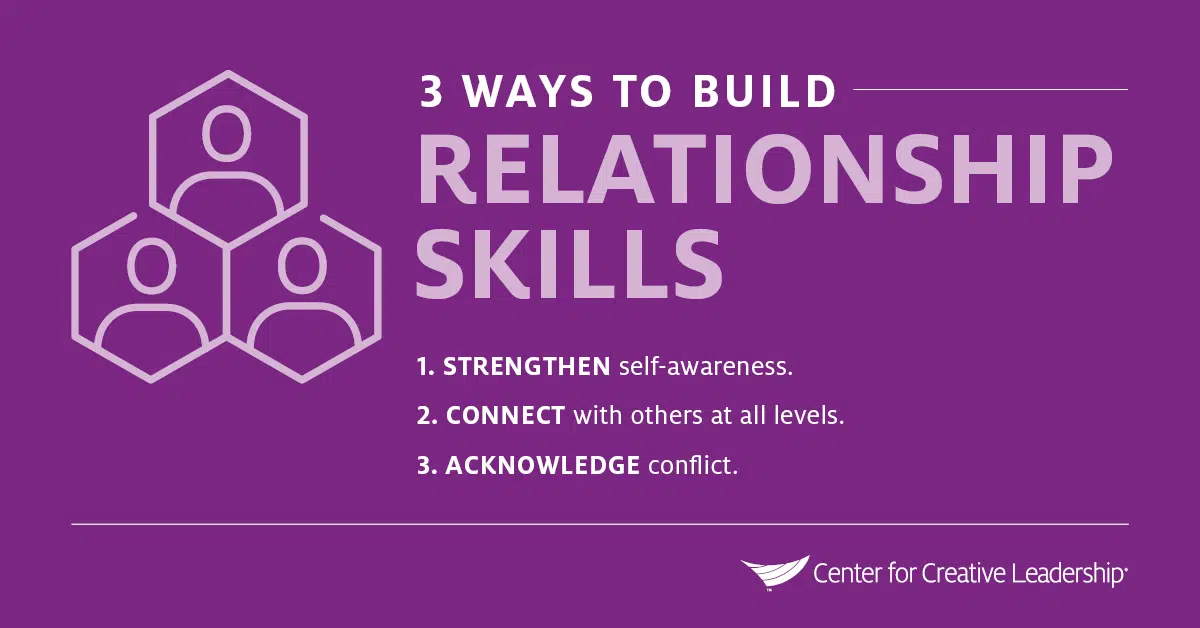
4 Tips for Building Relationship Skills at Work
1. Strengthen self-awareness.
The first step to building more effective relationships starts with being practical and assessing your abilities. Increase your self-awareness by starting to pay attention to how you interact with coworkers. Gauge your reactions to them, and take note of how they physically and verbally respond to you.
An important dimension of self-awareness for relationship-building is understanding how well you listen. Our research on listening found that employees’ perception of being listened to is twice as high when their leader both listened and took visible action in response. Listening without follow-through is experienced as performance, not presence. Ask yourself: When someone on your team raises a concern or shares an idea, what do they see you do next? That answer tells you something about your relationship skills.
This first assessment will help you grasp your standing with employees or coworkers. Once you’ve become more aware, start taking consistent steps to eliminate weak points and strengthen skills you already have.
2. Connect with others at all levels.
Building relationships across functions, levels, and geographies gives leaders a more accurate picture of what’s happening, surfaces problems before they become crises, and creates the foundation of trust that makes it possible to move quickly. You can’t involve people you don’t know. And you can’t align people you haven’t invested in.
That investment happens through consistent, meaningful attention and active listening, not only in formal settings but also in everyday exchanges.
When leaders have built those relationships, hard things get easier. Tough decisions land differently when the people affected already trust that you’ve listened and considered their perspective. Disagreement is more productive when there’s enough goodwill to absorb it. Connection at work doesn’t only make work more pleasant, it also makes leadership more effective at every level.
3. Navigate conflict without damaging the relationship.
Conflict is inevitable in any organization where people are committed to outcomes. Will leaders have the relational foundation to work through it without damaging the trust they’ve built?
Leaders with strong relationship skills understand that conflict and connection aren’t opposites. Healthy working relationships are what make productive disagreement possible. When relationships are thin, conflict tends to go 1 of 2 directions: polite avoidance, where disagreement migrates underground, or entrenched positions, where people defend their function rather than solve for the collective.
Leading through conflict means staying curious rather than defensive, addressing tension directly rather than letting it accumulate, and treating disagreement as information rather than a threat. Leaders who do this consistently strengthen relationships in the process, because working through something hard together builds a different quality of trust than smooth collaboration alone produces.
4. Treat feedback as a relationship investment.
Feedback is a high-leverage relationship-building tool, but it can also be misused. When delivered without care, it damages the relationship it was meant to strengthen. When delivered well, it signals investment in the other person’s growth.
The key shift is treating feedback as a relational act rather than an evaluative one. That means being specific about the behavior, not the person. It means delivering it close to the moment it’s relevant. And it means following up, because feedback that leads nowhere signals that you weren’t listening in the first place. Our Situation – Behavior – Impact (SBI)™ framework gives leaders a shared structure for delivering and receiving feedback in a way that builds trust.
Relationship Management Skills in the Workplace: The Foundation of Effective Leadership
Relationship building in the workplace is an ongoing practice that shapes how leaders show up in every conversation, decision, and moment of pressure. The leaders who do it well are intentional: paying attention to their impact, investing in the people around them, and treating connection as the strategic priority it is.
In workplaces where AI is accelerating the pace of work and distributed teams are the norm, those relational habits matter, and they require a deliberate effort to build. The good news is that relationship-building skills in the workplace can be developed at any career stage, and the return on that investment compounds over time, through stronger teams, better decisions, and a leadership culture that holds together.
Ready to Take the Next Step?
Upskill employees across your organization to help them excel at building relationship skills at work. Partner with us to craft a customized learning journey for your team using our research-backed modules. Available leadership topics include Collaboration and Teamwork Skills, Conflict Management Skills, Emotional Intelligence & Empathy, Self-Awareness, and more.