

As a leader, you know you need to coach others. If they perform well, you perform well.
And if you aren’t measured on your ability to develop and coach others — that’s likely to change soon.
Coaching provided by outside experts remains important and valuable. Many organizations also build coaching skills in their managers to develop teams and reach performance goals.
The challenge is that leaders are asked to develop their team but receive little guidance on the best practices for coaching others. So they give reviews and advice, but they don’t understand how to have a coaching conversation.
That’s why we’ve been partnering with client organizations to help them develop leader-coaches who understand how to be an effective coach, outlining specific actions for coaching people well.
How To Coach People Using 4 Core Skills
Remember the LACE Model To Coach Others Effectively
Our coaching methodology is based on research decades of experience coaching others in organizations around the world. We believe that whether you’re a professional leadership coach, or a leader with coaching responsibilities, you need to build both your skill at coaching others and the relationship itself.
Better conversations are built on 4 core skills, and those skills help leaders coach effectively. Our research with 1,852 leaders found a connection: those whose peers saw them practicing all 4 core skills were rated as more effective by their managers. Remember LACE, our acronym for holding conversations that coach others:
- Listen to Understand
- Ask Powerful Questions
- Challenge Thinking
- Establish Next Steps
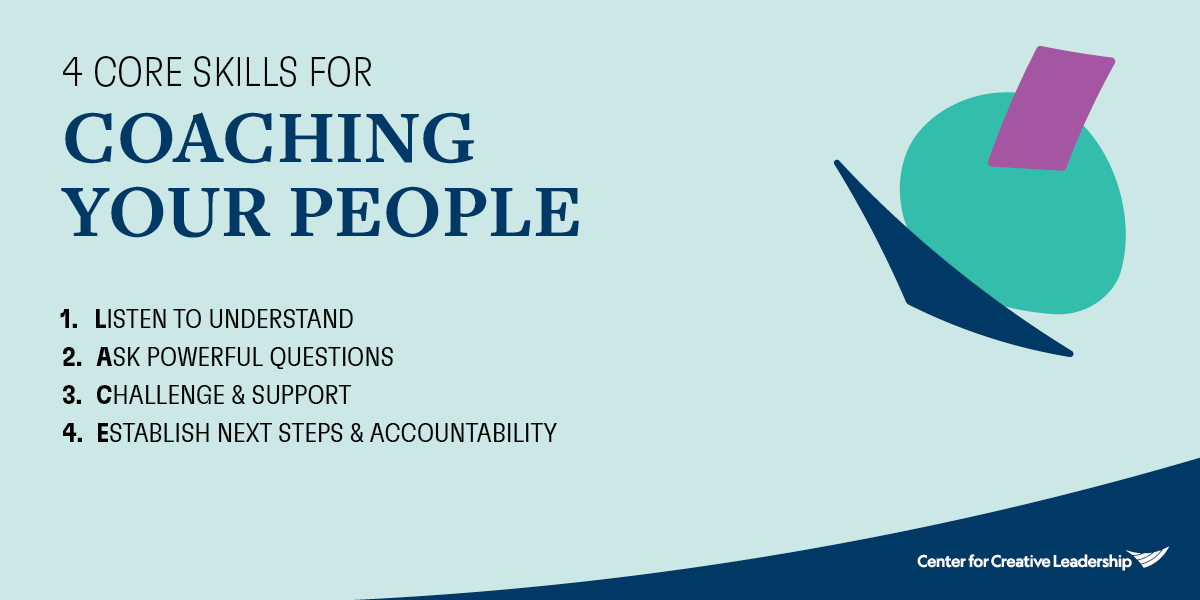
1. Listen To Understand.
Listening starts with paying close attention, repeating back concepts to build understanding, and summarizing what you hear. But listening to understand goes beyond these active listening techniques for coaching others.
Listening to understand someone starts with recognizing that multiple levels of information are conveyed in a conversation: facts, emotions, and values. Naturally, when listening, you pay attention to the facts being discussed. But listening to understand also means paying attention to other levels. Listen too for the values behind what the person is saying, as well as the emotions they feel about it. Notice their words, tone of voice, body language, and what seems to be most important for them. Coaching others well requires that you listen for all 3 levels, and you will really be listening to understand the other person’s perspective.
2. Ask Powerful Questions.
Asking powerful questions draws out insights and moves the conversation forward. Making non-directive inquiries that draw out more information and stretch the other person’s thinking is a learned skill that must be practiced. Examples of powerful questions include:
- What else could you do?
- Who else have you talked to about this?
- Who else is affected in this situation?
- How do you want the rest of the team to feel about this?
Beyond creating mutual understanding about facts, asking powerful questions like these when coaching others can help uncover insights and unspoken reservations that wouldn’t have been seen otherwise.
3. Challenge Thinking.
We all need our thinking challenged at times. Challenge can stress-test ideas, yield productive dialogue, and uncover unexamined assumptions. It can lead to stronger, shared understanding.
Ultimately, coaching people is about getting them to try something different from what they have done before, or creating a significant shift in perspective. It’s about uncovering answers through inquiry, openness, and exploration, and there usually aren’t quick fixes.
Challenge works best when people feel heard. When you show you understand how the other person sees the situation and how they feel, trust and psychological safety can grow. People then respond to challenge with curiosity, and the conversation becomes more honest.
4. Establish Next Steps.
Coaching conversations end well when everyone leaves with a shared understanding of what they discussed and a clear sense of what happens next. Next steps carry the conversation into action, so the insights and decisions it produced become progress. (“So, I’ll send you an email by Friday, letting you know how it went.”)
When a challenge feels complex, it’s easy to feel unsure where to begin. Simple techniques can help you guide someone from unsure to confident and clear, ready to take a first step. Small steps build momentum, which makes follow-through more likely.
“CCL’s program helped me take a step back to see from a different angle how I listen, ask questions, provide feedback and support. 80% of the program is the practical part, so you can start improving immediately.”
Strategy Development, JTI
Better Conversations Every Day Participant
To Coach People, Focus on the Relationship
Leader-coaches can aim for transformation, even in 10-minute hallway conversations.
But creating the right relationship is critical. This ensures you have a safe, trusting, and productive space for conversations where you coach others.
We believe effective leaders bring their whole selves to leadership. To be a leader-coach, focus on boosting your self-awareness, showing vulnerability and empathy, and creating an environment of psychological safety. In addition, set a foundation of high ethical standards and ground rules of agreement.
Once you have the tools and some practice with the 4 core conversation skills, you’ll find that coaching people through conversations is an effective way to develop and motivate your direct reports. And you will benefit, too. As you improve your skill at coaching others, you’re developing leadership capabilities that have benefits in other work relationships. A manager’s ability to build relationships, elicit information, challenge assumptions, and clarify goals helps them succeed as a leader.
Learn how to communicate better, connect more deeply, build trust, and be more satisfied — inside and outside of work — with our book, Better Conversations Every Day.
Create a Culture of Coaching by Scaling Conversational Skills
Organizations help their leaders perform better by developing them and building the support around them together. Coaching is a clear example. Helping leaders build the conversational skills they need to coach others effectively is the first step toward implementing a coaching culture across your entire organization.
Our philosophy is that everyone benefits when people are using coaching skills every day. The 4 core LACE skills improve conversations, create a common language, and give other initiatives a stronger base. Leaders build stronger relationships and strengthen psychological safety, which supports engagement and development.
Organizations that want to scale a coaching culture will also want to:
- Offer everyone access to developing skills at coaching others, regardless of where they are in the organization.
- “Seed” the organization with role models who coach people well.
- Link coaching outcomes to business goals.
- Coach senior leadership teams.
- Recognize and reward coaching behaviors.
- Integrate coaching others with other people-management processes.
Ready to Take the Next Step?
Individual participants in our conversation skills program for leaders learn how to coach others more effectively. Or, your organization can partner with us for enterprise-wide coaching and scale a culture of coaching others across your entire organization.