

• Published May 19, 2026
  • 4 Minute Read

How To Create a Strong Leadership Strategy

Learn why a leadership strategy is important for the success of your business strategy, and discover how to create one for your organization using our leadership strategy model.
  • Published May 19, 2026
Published May 19, 2026
How to Create a Strong Leadership Strategy: the CCL Leadership Strategy Model

Organizations depend on capable leadership to guide them through unprecedented changes. Yet there’s ample evidence that even some of the most established organizations are failing to adapt to change, implement their strategic plans successfully, or prepare for an uncertain future.

What can your organization do to avoid the risks associated with inadequate leadership strategy and better prepare your current and future leaders for unforeseen changes?

What Is a Leadership Strategy? Why Do You Need One?

A leadership strategy is a map that aligns investments in leadership development with the strategy, goals, and aspirations of the business.

A leadership strategy makes explicit how many leaders are needed, what kind, where they’re needed, with what skills, and behaving in what fashion, both individually and collectively to achieve the desired outcomes.

It also identifies other issues the organization must consider, such as whether current talent systems (like onboarding or performance management) support the culture and leadership the organization wants to create.

Every leader is aware that a well-defined business strategy is important. But few give thought to the leadership strategy that’s needed to make it happen.

Too often, organizations hold onto an old list of leadership competencies (or just keep endlessly adding to their existing list). Others create talent programs that are too generalized by not factoring in the specific business strategies of their organization.

This disconnected approach to developing organizational and individual leadership won’t equip senior management, up-and-coming talent, or everyday leaders to adapt to change and meet new goals.

When setting bold strategies that call for changes in the direction or capabilities of the organization, consider the leadership gap. One of the first questions to ask is: Do we have the leadership we need for the strategy we’ve set?

How To Create a Leadership Strategy

This is our recommended process to create a leadership strategy that we outline in our white paper:

First, Start With Your Leadership Drivers

The first step in developing a leadership strategy is to determine your organization’s key leadership drivers — the 3–5 determinants of sustainable competitive advantage for your particular organization in your particular industry.

You can’t create a leadership strategy that will be effective without this first critical step.

Then, Identify Leadership Strategy Implications

Once you’ve determined the key drivers, leadership strategy implications can be identified. For example, if becoming more innovative is a key driver for your organization, then the leadership strategy implications may be as follows:

  • Greater interdependence among leadership to create more effective collaboration across functions in bringing new products to market.
  • A need to increase leadership involvement across functions in gathering consumer insights and translating these into profitable ideas for new products.
  • Anticipating capital, space, and talent implications of rapidly expanding product portfolio.
  • A need for cultural change to create a spirit of innovation versus a culture of risk aversion.

In reality, the leadership strategy implications would be much more specific, reflecting the actual opportunities and issues surrounding the key drivers. The key drivers and their associated business strategies should have clear implications for what leaders must do well in order for the organization to succeed.

Ultimately, leadership development activities should be designed to ensure that individual leaders and the collective leadership of the organization are prepared to implement the most important strategies related to the key drivers.

The Leadership Strategy Model: 5 Factors

Setting a leadership strategy first requires a comprehensive understanding of leadership in your organization. This begins with individual talent and competencies, but it doesn’t end there. The ability of formal and informal leaders to pull together ultimately makes the difference in whether you accomplish your goals.

A comprehensive leadership strategy translates these strategy drivers into specific action and should take 5 factors into account, as illustrated in our Leadership Strategy model:
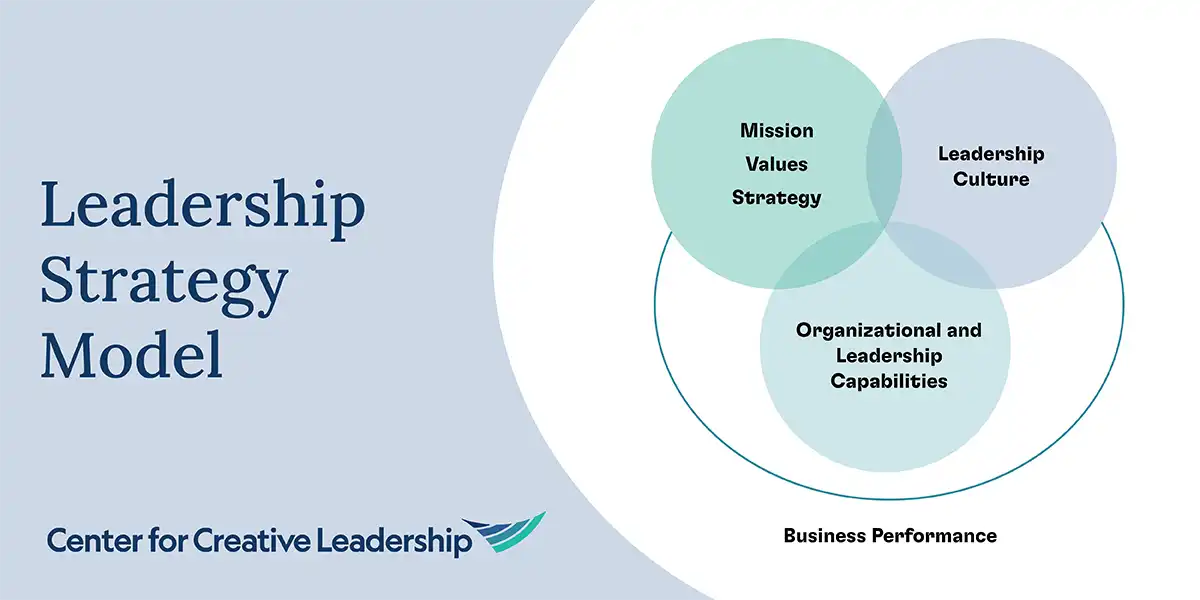
Leadership Strategy Model Infographic

In the leadership strategy model, 3 of the elements form the strategic spine:

  • Mission guides the organization’s efforts, regardless of how much the landscape shifts.
  • Values answer the “why” behind how leaders’ actions play out across the organization.
  • Strategy is the path the organization takes to secure sustained growth and success.

Equally critical, and inseparable from the rest, is the leadership culture, which is the shared beliefs, assumptions, and norms about leadership that shape how it’s understood, practiced, and rewarded day-to-day in an organization. Because culture is the human system of an organization, leaders carry outsized influence over it. How they show up, what they prioritize, and the standards they set shape not just leadership culture, but also the broader organizational culture that flows from it.

With the right leadership culture in place, all that remains is to activate it with the organizational capabilities that give the business its competitive identity, and the leadership competencies that leaders need.

Developing the leadership strategy needed to implement the business strategy takes careful planning, dedicated effort, and commitment from your organization.

But by going through the process of developing a leadership strategy using our leadership strategy model, you open the door for more targeted, effective leadership development — and an organizational culture capable of achieving strategic success.

Ready to Take the Next Step?

We can partner with you to help your organization create a leadership strategy that supports and aligns with your business strategy.

  • Published May 19, 2026
  • 4 Minute Read
  • Download as PDF

Based on Research by

Bill Pasmore
Bill Pasmore, PhD
Former Senior Vice President & Organizational Leadership Practice Leader

A thought leader in the field of organization development, Bill advises CEOs and Boards on challenges of the future including business disruption, new ways of organizing, creating more effective digital networks, leading continuous change, and improving senior team effectiveness. In his role as Senior Vice President, he led our efforts to help clients develop strategies to transform their organizations’ leadership cultures and capabilities.

A thought leader in the field of organization development, Bill advises CEOs and Boards on challenges of the future including business disruption, new ways of organizing, creating more effective digital networks, leading continuous change, and improving senior team effectiveness. In his role as Senior Vice President, he led our efforts to help clients develop strategies to transform their organizations’ leadership cultures and capabilities.

Jean Leslie
Jean Leslie, MA
Senior Fellow & Senior Research Scientist

Jean conducts applied research at the intersection of leadership and polycrisis, investigating how leaders can navigate the complex, interconnected challenges facing our world today. She’s published more than 100 pieces on leadership, assessment, and feedback — in the form of peer-reviewed articles, popular-press articles, book chapters, and books — and has presented over 70 papers at professional conferences such as the Academy of Management and the Society for Industrial and Organizational Psychologists.


Jean conducts applied research at the intersection of leadership and polycrisis, investigating how leaders can navigate the complex, interconnected challenges facing our world today. She’s published more than 100 pieces on leadership, assessment, and feedback — in the form of peer-reviewed articles, popular-press articles, book chapters, and books — and has presented over 70 papers at professional conferences such as the Academy of Management and the Society for Industrial and Organizational Psychologists.


Vicki Swisher
Vicki Swisher, MEd
Organizational Leadership Practitioner

Vicki partners with executive teams across a range of industries to define and activate leadership strategy, shape organization culture, and create a collective senior team culture. She has 20+ years of experience in leadership and organization development and has held executive roles in multiple global organizations.

Vicki partners with executive teams across a range of industries to define and activate leadership strategy, shape organization culture, and create a collective senior team culture. She has 20+ years of experience in leadership and organization development and has held executive roles in multiple global organizations.

George Hallenbeck
George Hallenbeck, PhD
Portfolio Manager, Custom Solutions

George manages our portfolio of custom solutions. He’s a recognized expert in the area of learning agility and has been engaged in research, product development, and client activities related to the topic for over 15 years. He has authored or co-authored 8 books, including Lead 4 Success: Learn the Essentials of True Leadership, which shaped the development of our Lead 4 Success leadership fundamentals course.

George manages our portfolio of custom solutions. He’s a recognized expert in the area of learning agility and has been engaged in research, product development, and client activities related to the topic for over 15 years. He has authored or co-authored 8 books, including Lead 4 Success: Learn the Essentials of True Leadership, which shaped the development of our Lead 4 Success leadership fundamentals course.

John B. McGuire
John B. McGuire, MBA
Honorary Senior Fellow & Former Practice Leader

John is an international authority on leadership culture and organizational transformation and the co-founder of our Organizational Leadership practice. He specializes in vertical leadership culture as the core mechanism in his change leadership methodology for the transformation of executives, their teams, and organizations.

John is an international authority on leadership culture and organizational transformation and the co-founder of our Organizational Leadership practice. He specializes in vertical leadership culture as the core mechanism in his change leadership methodology for the transformation of executives, their teams, and organizations.

What to Explore Next

CCL Regional Headquarters

AMERICAS

+1 336 545 2810
ccl.org

EUROPE, MIDDLE EAST, AFRICA

+32 (0) 2 679 09 10
ccl.org/emea

ASIA-PACIFIC, INDIA, CHINA

+65 6854 6000
ccl.org/apac

About CCL
ccl sail

At the Center for Creative Leadership, our drive to create a ripple effect of positive change underpins everything we do. For 50+ years, we’ve pioneered leadership development solutions for leaders at every level, from community leaders to CEOs. Consistently ranked among the top global providers of executive education, our research-based programs and solutions inspire individuals at every level in organizations across the world — including 2/3 of the Fortune 1000 — to ignite remarkable transformations.

At the Center for Creative Leadership, our drive to create a ripple effect of positive change underpins everything we do. For 50+ years, we’ve pioneered leadership development solutions for leaders at every level, from community leaders to CEOs. Consistently ranked among the top global providers of executive education, our research-based programs and solutions inspire individuals at every level in organizations across the world — including 2/3 of the Fortune 1000 — to ignite remarkable transformations.

Get our latest insights delivered to your inbox: ccl.org/subscribe.