

Today’s business landscape is dominated by complexity, churn and, too often, crises. These conditions have exacerbated an already challenging environment and elevated the importance of responding with agility, both individually and collectively. But while honing the ability to react in this way may help organizations weather these challenges in the near-term, it’s simply not enough for organizations and leaders to thrive.
Keeping pace won’t achieve and sustain competitive edge. This presents a clear urgency for organizations to focus on what will differentiate them and, by extension, what behaviors and mindsets leaders will need. It’s not easy to accomplish. Ambiguity clouds the present and the future. It’s also hard to draw a clear line between the behaviors and mindsets that guide leaders’ decisions and actions, and the organization’s broader strategic aims.
How Organizational Capabilities Relate to Leadership Strategy
We’ve identified a pathway that more clearly connects what leaders practice every day to long-term, sustainable organizational success. Our Leadership Strategy Model draws on our decades of research and experience and centers on 5 interconnected elements, with organizational capabilities as the vital link that connects strategy to the leadership behaviors that are most important to build.
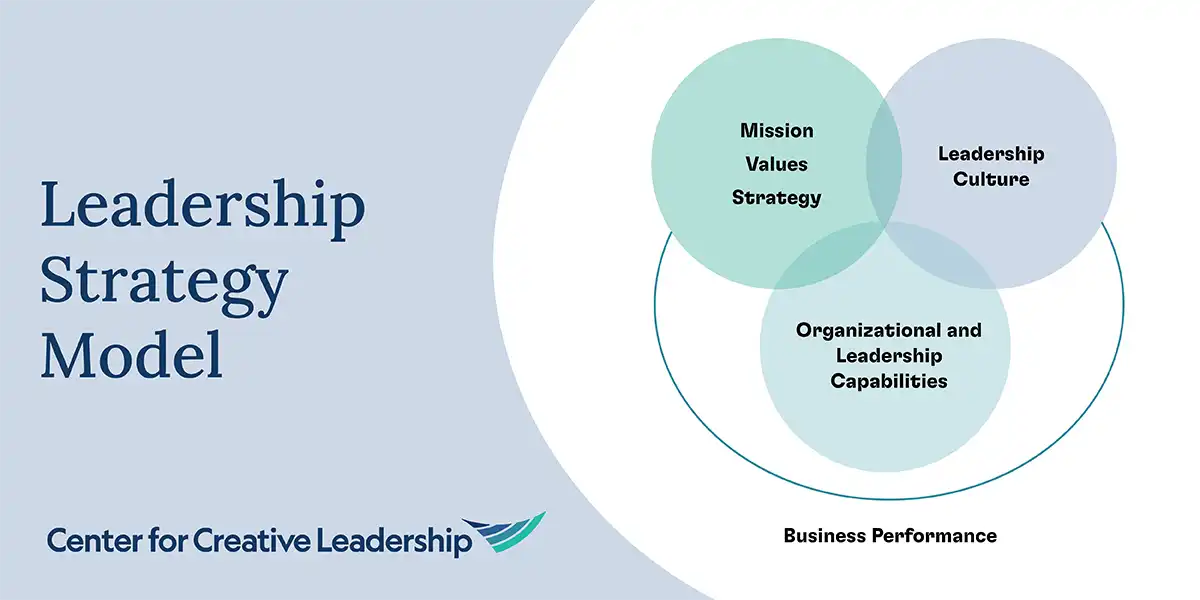
Mission, values, and strategy form its strategic spine. Equally as important is leadership culture, the shared beliefs and norms that shape how leadership is practiced and rewarded day-to-day. From there, organizational capabilities give the business its competitive identity, while leadership capabilities help leaders build and sustain them. Together, they turn strategy into action.
Too often, we see organizations move directly from business strategy to individual leader behaviors, never pausing to define what they need to be collectively great at. Organizational capabilities serve as the bridge, and getting clear on them first is what makes everything that follows, including which leadership behaviors to prioritize, far more purposeful and precise.
What Are Organizational Capabilities & Why Do They Matter?
Organizational capabilities capture what an organization collectively knows and does — both its strengths and the areas where it falls short. They are a strong signal of which customers the business is best positioned to serve and which strategies it is most likely to execute successfully. Organizational capabilities live in observable leadership behaviors that can be tracked and measured. And they only exist when people bring the right combination of skills, knowledge, and attributes to the work, making it impossible to separate collective organizational capabilities from individual leader behaviors.
Expecting strategy to come to life through individual behaviors alone, without first identifying what the collective capabilities need to be, creates a critical gap. Leaders miss the context to prioritize the right behaviors, and the organization lacks the coherence to execute. When organizational capabilities are well-defined, they align the business and human systems to operate in sync, creating value in ways competitors cannot easily replicate.
Organizational capabilities aren’t a new idea. Business thinkers in the 1990s shifted the conversation from an external focus on markets to a closer look at what organizations are internally best at, forcing leaders to make deliberate trade-offs about where to invest. That thinking has evolved, most notably to account for how organizations must adapt their capabilities amid perpetual disruption.
For decades, our Organizational Leadership practice has applied our research-based set of organizational capabilities with clients undergoing large-scale change and transformation. This work has been guided by our focus on leadership as a social process, and the shaping influence of leadership culture in demonstrating capabilities. We studied the work of dozens of executive teams over 20 years to arrive at a set of capabilities that played a role in successful organizational transformations.
Recently, we revisited this work to account for how capabilities have evolved due to technological, global, and other influences. We also added detail to the behavioral components of the capabilities to fine-tune understanding and facilitate the connection to leadership capabilities.
Our Research-Based Set of Organizational Capabilities
Our work has led to a set of 11 capabilities, each aligned to an organization’s strategic and cultural identity and reflecting what it looks like in action:
- Setting Strategy: Align systems and anticipate trends to compete for sustained performance.
- Leveraging Culture: Position culture as strategic differentiator, strengthen what works, and adapt as conditions warrant.
- Leading Transformation: Create a compelling vision that build shared purpose and aligned beliefs and behaviors.
- Managing Organizational Change: Guide change across boundaries through clear roles, milestones, and active stakeholder engagement.
- Facilitating Agility: Adapt quickly through learning, flexibility, empowerment, and knowledge-sharing.
- Driving Productivity: Optimize systems, workflows, people practices, and resources
- Fostering Innovation: Create the environment for experimentation, technology-enabled innovation, and faster product and service launches.
- Harnessing Collaboration: Use team-based collaboration and diverse perspectives to co-create solutions and deliver greater value.
- Determining Performance: Align performance measures, feedback, and rewards to clarify accountability and drive organizational succes.
- Focusing on the Customer: Build strong partnerships by anticipating needs, tailoring solutions, and centering business priorities on customers.
- Assuring Talent: Build future capability by using aligned talent practices to acquire, develop, and retain talent.
All of these contribute to a high-performing organization. The challenge is to identify the particular subset of organizational capabilities, typically 3–4, that become the focus of excellence for each organization. Taken together, the chosen capabilities tell a clear story about how the organization positions itself to meet strategic challenges and what it distinctly does to achieve success.
Consider a services company that’s committed to overhauling its approach in order to become an AI-driven organization, making AI the backbone of its processes and also infusing it into client offerings. If the organization already has strengths in Fostering Innovation and Driving Productivity, the executive team might agree to further build on those capabilities and emphasize behaviors such as quickly creating new products and services and effectively bringing them to market and continually shaping the organization’s structure and workflows. At the same time, given the scope and scale of the effort needed to fundamentally change the way it operates, they might determine that the organization will require building a Leading Transformation capability while perhaps reframing their focus on Determining Performance.
Narrowing to the right 3–4 organizational capabilities isn’t a simple exercise in consensus-building. It requires careful consideration of multiple factors, including which capabilities to invest in and what represents acceptable performance for the rest.
The more aligned the executive team and other stakeholders are about the essential capabilities, the clearer and smoother the path for establishing and sustaining them. We have been guiding executive teams through this process for decades, with a well-established approach that yields direction, alignment, and commitment — and paves the way for translating organizational capabilities into both the individual and collective leadership behaviors that bring them to life.
A 3-Phase Approach for Executive Teams
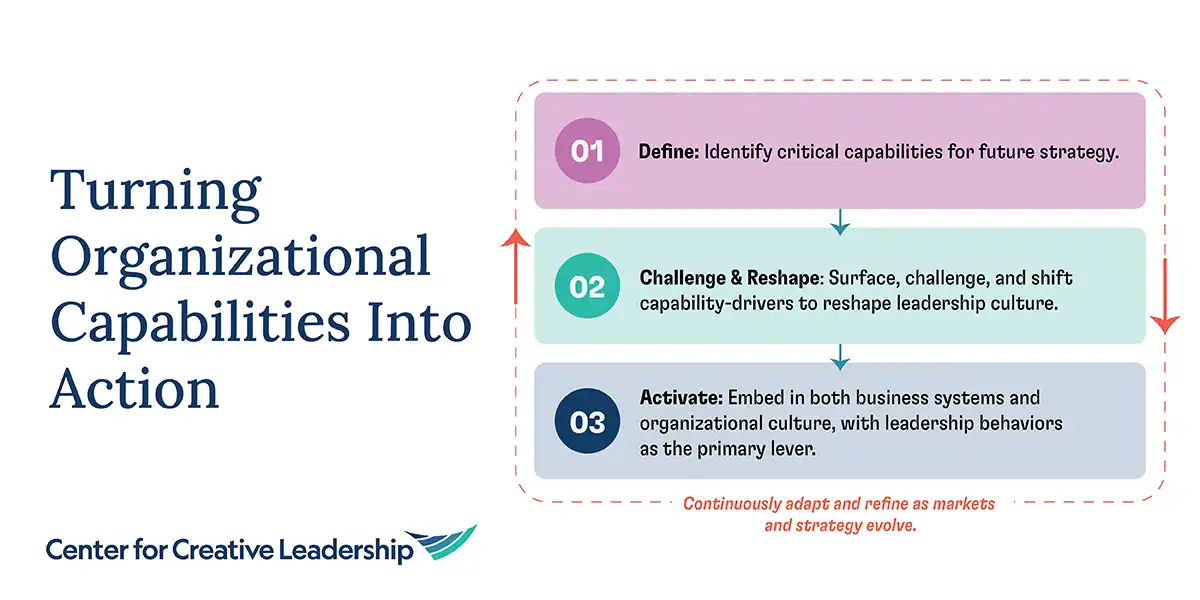
Turning organizational capabilities into action means looking both forward and inward, and that dual focus is the foundation of our 3-phase approach:
- Define: Get clear on what the organization is genuinely good at today, and what needs to be built, evolved, or deliberately de-emphasized to meet the demands of multiple possible futures.
- Challenge & Reshape: Surface and examine executive team belief systems, those deeply held assumptions that show up in decisions, priorities, and ultimately, in which capabilities thrive or stall. Where those beliefs are misaligned with what the strategy requires, we help challenge, shift, and realign them, shaping a leadership culture where the right capabilities can take root and thrive.
- Activate: Translate those priorities into both business systems and culture that makes capabilities operational, with leadership behaviors as the primary lever. Throughout this phase, the executive team should stay attentive, continuously revisiting and refining capabilities as markets shift and strategies evolve.
Translating Strategy Into Leadership Practice
As you envision the future for your organization and its leaders, consider organizational capabilities as a key bridging mechanism. By focusing energy on defining and building the organization’s differentiating strengths, organizational capabilities position the enterprise for strategic success and bring clarity to the specific behaviors leaders need to excel in.
The future will change, and so will your strategy and what leaders need to do to execute it. But when an organization aligns mission, values, strategy, and leadership culture around that focused set of capabilities, it strengthens both execution today and its ability to adapt tomorrow — keeping every part of the Leadership Strategy Model, and everyone in it, on the right track.
Ready to Take the Next Step?
Identifying the organizational capabilities that turn your strategy into a competitive identity — and building the leadership culture to sustain them — is consequential work for an executive team. We guide organizations through this process, and we’re ready to partner with yours. Learn more about our Organizational Leadership consulting services and how we help executive teams define, align, and activate the most important capabilities for sustained business performance.