

Organizations that invest in leadership development need clear evidence that those investments are driving business results. Leadership evaluation provides the insight needed to assess whether development efforts are delivering measurable value relative to the time and resources invested.
If you’re responsible for evaluating leadership initiatives and reporting outcomes to key stakeholders, a practical framework for gathering and making sense of information can help you demonstrate impact, inform strategic decisions, and strengthen confidence in future leadership investments.
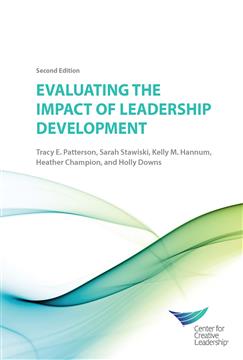 In the second edition of Evaluating the Impact of Leadership Development, we’ve compiled our best, most hands-on learning about how to measure leadership development. Created for anyone who has leadership development or evaluation responsibilities, this short how-to guide includes everything you need to organize, implement, and report on the impact of leadership development programs.
Here are some key points from that book, along with additional research findings on how to measure leadership development, to help you make the most of your evaluation efforts.
The Benefits of Training Evaluation
4 Reasons To Measure Impact
Here are 4 ways in which evaluation benefits leaders, organizations, and communities:
1. Evaluation clarifies outcomes.
Evaluation helps us better understand and document the desired outcomes of leadership development. It can encourage more comprehensive discussions about what works and why. Evaluation seeks to systematize large concepts. It separates real outcomes from wishful thinking, slogans, or vague program aspirations.
2. Evaluation focuses attention.
Evaluation pinpoints needed leadership competencies and directs attention to critical issues. When leadership development efforts use evaluation effectively, there is a clear intention about what to achieve and why. If, for example, a team knows that a goal of their leadership development is to improve group decision-making, the members of the team can change their behaviors accordingly. If they know they will be evaluated specifically on those behaviors, the impetus is even greater.
3. Evaluation supports ongoing learning.
Evaluation can be used to fine-tune a proposed or existing leadership development intervention. It can provide constructive observation to guide a program’s evolution. Once a program is established, evaluation continues to contribute by helping the program managers optimize their use of resources on behalf of the participants. Just as important, evaluation contributes to a learning mindset — a perspective that values asking questions, assuming multiple perspectives, and challenging assumptions.
4. Evaluation influences future actions and decisions.
Evaluation serves to demonstrate more fully how participants, their organizations, and their communities benefit from their leadership development program experiences. This information can then be used to make choices about future efforts.
Evaluation is learning, and learning is evaluation. So view program evaluation as an integral part of the development process, and you’ll be able to build on what’s working well and eliminate efforts that are less effective.
How To Measure Leadership Development
6 Research-Based Recommendations
Based on our extensive experience, research, and best practices in the field, we recommend following these 6 steps in the earliest stages of program planning and design for optimal evaluation results.
1. Engage evaluation stakeholders.
The primary purpose of evaluation will stem from the needs of stakeholders, so identifying who they are and learning about their expectations, concerns, and perceptions is important. Stakeholders could be those who are involved directly — participants or delivery team — or those who could invest in the initiative or are affected by it.
Then, determine whether all stakeholders are in agreement about the initiative and aligned in terms of outcomes or intended impact. Without this step, you miss an opportunity to plan for, and collect, valuable information for measuring impact. When you put the effort in at the beginning, you can increase the likelihood that the results will be both relevant and helpful.
2. Connect with the initiative design.
Evaluators need a solid understanding of the organizational challenges driving the need for leadership development, who the initiative targets, and what their leadership needs are. Then, the more difficult part: figuring out the specific measurable objectives of an initiative. Evaluation design is based on knowing the connection between each program element and what it’s trying to achieve. Considering evaluation early on can strengthen the design of the initiative, revealing details or disagreements that had been overlooked, as well as unnecessary elements or gaps in the program design.
3. Focus the evaluation.
Narrowing the scope to what is most critical to measuring impact is the next step. It’s easy to end up collecting more information than you need, or miss collecting something that ends up being of great interest to your stakeholders if you breeze through this part of the process. Plus, you can also avoid conflict down the road if you can simplify and summarize the evaluation at this point, so stakeholders get another chance to understand and buy into what you’re doing to measure impact.
4. Confirm resources and expectations.
Are resources available to match expectations? Often, the 2 are not aligned. Taking a reality check at this point allows time, people, and budget to be realistically factored into the evaluation process.
5. Determine data collection methods.
Surveys, interviews, focus groups, observation, and documentation are common data collection methods, and each has advantages. Different combinations will work best, depending on what data will be gathered, from whom, how, and when. This is also the time to talk through the burdens placed on the people providing the data, address issues of data security and confidentiality, and adjust the timeframe for data analysis and interpretation based on the final design.
6. Plan for communication of results.
There are many ways to share evaluation information and often several audiences. Determine the best way to communicate up front, so it can be factored into the planning. The goal is to put useful impact data into the hands of stakeholders when they need it and in a way that encourages discussion and action.
Measuring leadership development is always a complex challenge. Taking these 6 steps, in the beginning, gives you the best opportunity for success.
How To Design an Effective Evaluation
5 Questions To Ask
A hallmark of evaluation is to provide observers, participants, and decision-makers with a sense of how well something is working, or not. A good evaluation design is based on a solid understanding of the expected outcomes of the program and an understanding of who cares about the program, and what their expectations are.
To design an effective evaluation of leadership development, ask these 5 key questions:
1. Who are the people who care most about the evaluation findings?
The evaluation will be most useful if it’s designed based on the expectations, concerns, and perceptions of key stakeholders. Stakeholders could be those who are involved directly — participants or the program staff — as well as organizational leaders and others who could invest in the initiative or are affected by it.
2. What changes do we expect from our program?
Evaluation design is based on knowing the connection between each program element and what it’s trying to achieve. What knowledge and skills is the program designed to develop? What actions or behaviors reflect those desired lessons learned? How will we know learning has occurred? What’s the definition of success? What degree of improvement is expected?
When these questions are answered by stakeholders early on, it can not only inform what you evaluate but also strengthen the program design. It can reveal details that had been overlooked as well as unnecessary elements or gaps in the program design.
3. What’s most critical to measure?
Narrowing the scope of what you evaluate to what’s most critical is the next step. If you breeze through this part of the process, it’s easy to end up collecting more information than you need or miss collecting data that ends up being of great interest to your stakeholders. Plus, you can avoid conflict down the road if you can simplify and summarize the evaluation so that stakeholders get another chance to buy in to what you’re doing.
As you think through the factors you want to measure, consider our simple framework for evaluating training outcomes. Our researchers developed this framework after decades of implementing and evaluating the success of leadership development programs.
First, understand the levels of impact a development program can have. These 4 levels range from the individual, to the group, to the entire organization, to all of society. Levels of impact are connected outcomes that ripple outward over time; by understanding these levels, you can clarify your expectations.
It’s important to note that not all leadership solutions are expected to exert their impact on all 4 levels; the expected impact on a given level will depend largely on the specific goals of each solution.
Next, consider 3 contributing factors, which include:
- Leadership characteristics: Are participants prepared, and are they fully engaged?
- Leadership solution: This is the content itself, the development’s design characteristics and the way in which it’s delivered.
- Context: Does your organization’s culture and leadership support development?
Our research on evaluating the impact of leadership development reveals that, as you consider what’s most critical to measure, it’s helpful to focus on the factors that can actually help to maximize the impact of your leadership development initiatives. That way, you ensure the design of the solution is relevant to the challenges faced by your leaders, is delivered in a way that engages leaders, and accounts for contextual factors.
4. How will we gather useful data?
Each data-collection method has a purpose. For example, behavioral change can be captured by a 360-degree assessment designed to measure change, while focus groups or interviews are a useful way to gain an in-depth understanding of the obstacles people face in implementing desired behavioral changes.
End-of-program surveys measure immediate responses to the program, but they don’t reveal the results of individual development in the way that post-program surveys and interviews can. Social media, phone apps, pulse surveys, and self-monitoring technologies enable you to capture real-time and continuous feedback for participants, along with rich data on behaviors and their impact on business results.
5. What did we learn, and what do we do about it?
The whole reason you evaluate an initiative is to draw meaningful conclusions from data and use them to make informed choices. So it’s important to build in time and commitment to discussing evaluation results, as well as planning how to use them.
If you’ve identified the definition of success for those involved in the program and its future, you’ll be able to present defensible interpretations of the data and make valuable recommendations for how to improve and continue the program.
Some Dos & Don’ts for Measuring Leadership Development’s Impact
Best Practices Based on Experience
With over 50 years of experience helping HR teams evaluate their leadership development initiatives, we’ve seen what works — and what doesn’t. Take a look at these tips for how not to measure impact, and instead, let the Dos guide you down the right path.
1. Don’t delay.
It may be tempting to focus on delivering the initiative now and worry about the outcomes later. But if you wait until after implementation to design the evaluation and start measuring impact, you miss the chance to ensure that the design is tied to expected outcomes and to build measurement into the process. One of the benefits of evaluation is the thought process that goes into it — thinking about what matters enough to measure later helps to clarify the goals of the effort today.
Do design the evaluation as you’re designing the initiative, and well before it’s implemented.
2. Don’t deny.
It’s easy to assume good things will happen when you provide learning and development. But your efforts may miss the mark, or have unintended consequences. If you don’t take a good, research-based look at measuring impact, you lose the chance to learn from mistakes and capitalize on successes.
Do use evaluation as a tool to enhance organizational learning.
3. Don’t rush.
External deadlines and directives for development may create urgency — but don’t forget to focus. Slowing down to ask the right questions is essential for getting results that will matter to your organization.
- Do spend time on discovery. At CCL, we have a comprehensive discovery process of partnering with you to uncover and understand your leadership development needs.
- Do discuss and define the purposes of each evaluation.
4. Don’t work in isolation.
Make sure appropriate stakeholders (Executives? Participants? Their managers? External funders?) are clear on expected outcomes and what they want from the evaluation. If you wait until after evaluation data are gathered to include stakeholders in the evaluation, they can argue about what was wrong with the process, rather than use the data to move toward a shared goal.
- Do involve stakeholders at all stages of the process.
- Do create organizational support for leadership development initiatives and evaluation.
5. Don’t oversimplify.
Don’t just focus on what you can control or the most obvious metrics. Evaluation can, and should, factor into the complexity and reality of leadership development in organizations.
Do consider multiple measures, multiple perspectives, and measures at multiple points in time in order to gain a comprehensive perspective of program processes and outcomes.
6. Don’t override.
If you or a business leader or colleague doesn’t like a part of the evaluation process or a question that’s asked, don’t just change it.
Do work with your evaluation experts to deal with concerns or changes — and to understand the evaluation design and methodology.
7. Don’t blame.
Evaluation data will likely reveal problem areas. Don’t use the measurement data as ammunition; instead, use it as fuel for improving and learning.
Do be honest about the data, even if it shows shortcomings.
8. Don’t halt progress.
An evaluation provides information that can help you create broader change and learning at your organization — but not if a few slides make it into your next presentation, and then the report is filed away.
Do use the evaluation findings. Figure out how to effectively communicate the findings, identify specific courses of action, create action steps, and see them through.
How To Evaluate Leadership Development at the Organizational Level
A Special Note About Culture Change Initiatives
Organizational culture change is about changing beliefs, assumptions, and attitudes — and changing these things is never easy or fast.
That’s why we recommend moving from a mindset of measuring results to ongoing evaluation. Strategically collecting, analyzing, and using data along the way can tell you whether your culture change initiative is successful and provide insights that can make your efforts more effective. Using data to gain insights throughout the process can shift beliefs and practices — and lead to real, long-lasting organizational change. And for more detailed guidance on measuring culture change initiatives, read our white paper on culture change strategy evaluation.
As with other types of evaluations, the most effective way of measuring a culture change’s impact requires planning before the initiative even begins. Make learning integral to the change process. Think about the impact desired and what you want to achieve early, and use data to drive insights throughout the culture change process. With careful planning, your leadership development evaluation can provide valuable information about the impact of your investments.
Ready to Take the Next Step?
We can help your HR team create scalable but personalized leadership development to ensure you get the results that matter most to your organization. We can provide customized leadership development for your unique context and culture, and our Leadership Analytics experts can help you with diagnosing your current state and measuring impact.