

Organizations seek leadership development programs to help leaders think differently, act more intentionally, and contribute more effectively. Increasingly, the expectation to demonstrate meaningful impact comes with the investment itself.
Evaluation supports that goal, but only when it’s designed with intention.
The most useful leadership development evaluations don’t attempt to measure everything or reduce impact to a single metric. Instead, they focus on providing the right evidence for the questions decision-makers are trying to answer:
- What did leaders take away from the experience?
- What changed for them?
- Where are they applying what they learned?
- Where might they need more support?
Leadership development doesn’t produce a single, uniform outcome. Its effects are personal, contextual, and social. Some changes appear quickly, while others emerge as leaders test new approaches in real situations. Impact is best understood as a pattern of evidence across individuals, relationships, and systems.
Consider how far that pattern can extend. In one statewide initiative, school principals in Vermont attended a leadership development program. Early signals were promising: Participants experienced greater psychological wellbeing and stronger collaboration with peers. Teachers noticed positive changes in their principals. Over time, principal turnover dropped across the state, saving an estimated $1.4 million. A program designed to develop individual leaders ultimately produced measurable system-level change.
Organizations feel the tension between growing pressure to demonstrate impact and leadership development evaluation approaches that oversimplify what the experience produces. A broader view of evidence may help resolve that tension. Quantitative data can highlight trends, particularly at scale, but it captures only part of the story. Many of the most meaningful changes involve how leaders think, decide, and engage with others.
Our approach is informed by decades of experience evaluating leadership development impact. We view evaluation not as a single method or outcome, but as a set of intentional choices about what evidence will be most useful at a given moment. This perspective shapes our core evaluations and provides a strong foundation for understanding impact while also allowing organizations to expand and deepen evidence as their questions evolve.
Evaluating Leadership Development Programs: Impact Doesn’t Arrive All at Once
Because the impact from leadership development emerges as a pattern of evidence rather than a single data point, it doesn’t look the same for every leader, and it certainly doesn’t happen all at once. Development is shaped by who leaders are, the roles they hold, and the situations they face when testing and learning new ways of thinking and leading.
As a result, the same experience between leaders can spark wildly different kinds of growth. One leader may gain clarity about priorities. Another may become more aware of how they respond under pressure. Yet another may feel more prepared to engage in conversations or decisions they previously avoided. These differences reflect how leadership development meets leaders where they are.
Timing is also a factor. Some effects appear quickly, such as new insights or motivation. Others emerge later, as leaders test ideas in practice and encounter reinforcement or resistance from their environment. Especially early on, many outcomes are catalytic: They set direction and build momentum, even if change isn’t fully visible or consistent.
Seen this way, leadership development impact takes shape over time, influenced by context and experience. Evaluation is most useful when it helps organizations understand what is beginning to shift and where that shift may lead.
How We Think About Leadership Development Impact
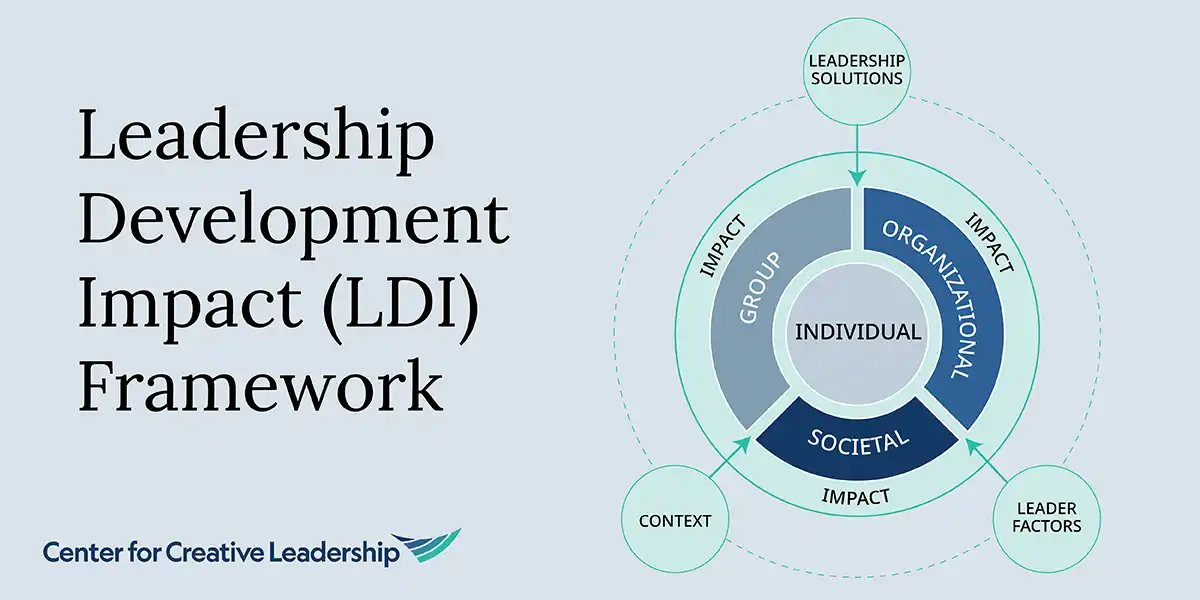
Measuring the impact of leadership development requires understanding impact. Not just what it is, but what enables and undermines it. Our Leadership Development Impact (LDI) framework is how we do evaluation, and it starts with the conditions that produce a successful program:
- Individual factors: the readiness, motivation, and circumstances of the leader
- Context factors: the organizational environment that supports or constrains application and growth
- Program factors: the design and delivery of a development experience
Our research on learning motivation and support shows that learning isn’t just a product of curriculum, it’s also dependent on the people and the environment.
The leader who comes hungry for development isn’t going to experience the same program as a leader who has one eye on their email. The one focused on their email may want to engage, but wasn’t given the necessary support from their organization to fully take advantage of their developmental experience — and both the leader and their organization could lose out.
Facilitating the conditions for a successful leadership development experience doesn’t just mean the leader learns new skills. Successful experiences have the potential to impact:
- Individuals: shifts in identity, mindset, skills, and behavior
- Groups or teams: changes in relationships, communication, and how leadership happens collectively
- Organizations: patterns related to culture, norms, systems, and shared leadership expectations
- Broader systems or communities (where relevant): influence that extends beyond a single team or organization
These areas of impact aren’t mutually exclusive, and development at any level can flow to other levels and back. We know that leadership is a social process, and it happens through people.
The LDI framework reinforces a core idea: Leadership development is rarely the sole cause of outcomes. Instead, it functions as an inflection point, influencing how leaders interpret experiences, make choices, and engage with others within a larger system.
The leader who learns better approaches to feedback will promote trust and psychological safety on their team. The team that adopts better boundary spanning practices will improve cross-team collaborations and collective success.
Leadership development doesn’t happen in isolation, and neither does leadership impact.
From Inner Shift to Outer Impact
Impact may not follow a single path, but it tends to reflect a progression from internal clarity to outward application over time.
Leadership development often begins with identity and confidence.
A common early outcome of leadership development is a shift in how leaders understand themselves and their role. Leaders often report greater self‑awareness, including clearer insight into their strengths, tendencies, and impact on others. Many also revisit their internal standards for effective leadership, refining what they pay attention to and how they evaluate their own choices.
These shifts shape how leaders interpret situations and make decisions moving forward. Even when they remain largely internal at first, changes in identity and confidence often influence later action in meaningful ways.
What does modest confidence improvement signal? One leader chooses to pursue an innovation they previously deemed too risky to share. Another feels more empowered to speak up in meetings where they were previously quiet. A third applies for a VP role that they never would have considered before. Each reflects a different outcome and a different impact. These aren’t hypothetical; they’re real stories from leaders who attended our leadership development programs and experienced their world differently afterward.
Tools and skills are adapted, not adopted.
These internal changes don’t operate in isolation, but rather directly shape how leaders interpret and apply the tools and frameworks they’re given through their leadership development. Early on, leaders often experiment with these tools, using them selectively based on role, context, and immediate challenges. Over time, leaders incorporate what proves most useful into their style. Zooming out, this causes skill development to look uneven and individualized, reflecting opportunity and readiness rather than a fixed sequence of mastery that can be followed.
Leadership is relational, and so is leadership development.
As these tools become integrated into a leader’s personal approach, their impact becomes visible in how they show up in relationships with others. Teams may experience clearer communication, increased openness, or stronger collaboration as leaders apply new approaches. In many cases, these relational effects become noticeable even as individual leaders continue refining their own practice.
Because leadership inherently invites followership, these shifts can offer valuable insight into how development is shaping the broader environment leaders work within.
Organizational impact accumulates through shared experience.
As these relational shifts compound, they move beyond individual interactions and begin to form shared patterns that shape how the organization operates, especially when leadership development occurs across multiple cohorts or longer journeys. Leaders develop shared language and expectations, approaches become more aligned, and connections at work strengthen across boundaries as common challenges and priorities emerge. These outcomes develop through accumulation rather than immediate change, becoming clearer as leaders continue to encounter new situations together.
Our Consistent Foundation for Measuring the Impact of Leadership Development
Understanding how impact unfolds is the starting point. The next question is how to measure it and where to begin. A core set of evidence reliably supports meaningful understanding of impact.
At CCL, our standard evaluation is designed to identify early indicators of impact that show what leaders are taking away from an experience and how they’re beginning to apply it. It centers participant experiences as a valid form of evidence, because leaders themselves are best positioned to describe what shifted in their thinking, what felt most relevant, and what they intend to try next.
Our standard evaluations focus on:
- Participant experience and engagement
- Relevance and applicability of content
- Key insights and takeaways
- Intentions and early attempts to apply learning
This evidence helps organizations understand what part of a program resonated most and with whom, and where leaders are likely to focus their energy when they return to their roles. Because it’s grounded in participant experiences and voices, it also captures early signals that are otherwise easy to miss, such as how leaders are reframing challenges, what they believe will make the biggest difference, and what support they anticipate needing. It supports learning and improvement, strengthens communication with stakeholders, and provides a clear view of what is emerging and where additional support may be valuable.
Build Leadership Development Evaluation To Match Your Needs
Standard evaluation evidence provides a strong foundation for understanding this early impact. From there, organizations can expand their approach to explore additional questions around application, sustainability, and broader influence by intentionally collecting evidence aligned to their goals.
There are several ways evaluating leadership development can be expanded or deepened to support those goals.
Qualitative data is undervalued.
Quantitative data supports comparison and pattern recognition. Qualitative insight provides meaning, explanation, and context. Participant voice isn’t anecdotal; it’s often the most direct evidence available for internal shifts (mindset, confidence, judgment, intent) that precede and shape observable behavior. Together, quantitative and qualitative evidence offer a more complete understanding than either would alone.
While our standard leadership development evaluation contains a mix of data types, more in-depth qualitative data in the form of interviews, focus groups, or other analyses add unparalleled depth. When collected systematically (for example, using consistent questions and careful analysis across participants), qualitative evidence strengthens validity by showing not just that change may be happening, but how leaders are making sense of it and translating it into action.
Time reveals what sticks.
Follow-up after a leadership development experience offers a clearer view of how learning is carried into practice. It reveals what leaders are trying, where they encounter challenges, and how application varies across contexts. This helps organizations understand what is taking hold and where support is needed.
Immediately after the program, receptiveness to the content, initial reactions, and intentions are core metrics that relate to later uptake. After 2 months, leaders are likely to have started testing new ideas and skills. In 3–6 months, simpler skills, mindsets, and behavior changes start to show. Remember that different outcomes have different rates of change; a mindset shift may be near-instantaneous but organizational culture shift will take years.
Multiple perspectives strengthen interpretation.
In some cases, organizations benefit from incorporating perspectives beyond the participant. Input from managers, peers, or others who work closely with leaders can shed light on how changes are being experienced and interpreted in the surrounding environment.
Multi‑perspective evidence adds richness to interpretation and can strengthen confidence in what is emerging. This is particularly true when organizations want to understand how leadership development is showing up in day‑to‑day interactions without requiring experimental designs or the need to prove that the program alone caused the change.
Patterns become visible across cohorts and levels.
When leadership development occurs across multiple cohorts or as part of a longer journey, it becomes possible to look beyond individual experiences and consider broader patterns. Shared language, priorities, and approaches to leadership may begin to take hold across teams or groups.
This type of evidence is especially useful for leadership strategies intended to shift norms, strengthen relationships, or support more collective forms of leadership, where impact is expected to build through accumulation rather than immediate change.
Relationships themselves are an outcome.
Evaluation can focus on relationship building and collaboration within intact cohorts or working groups. Examining how leaders connect, coordinate, and work across boundaries within these groups can illuminate how leadership development influences shared work and collective capacity.
These approaches are best suited for small groups and intentional designs, where relationships themselves are a central part of the development effort.
Organizational data provides context and scope.
When aligned with existing internal data, evaluating leadership development programs can also draw on broader organizational indicators such as engagement, inclusion, or mobility patterns. Used thoughtfully, these indicators help place leadership development within a larger organizational context.
At this level, evidence supports interpretation rather than attribution by offering insight into how leadership development may be contributing more broadly.
However, it’s best not to think about these elements as sequential upgrades. They can be combined and tailored based on the questions an organization wants to answer and its appetite for evidence, creating an evaluation approach that is both purposeful and proportionate.
An effective leadership development evaluation offers a structured view of selected outcomes at a particular moment. What it can illuminate depends on the questions being asked, when evidence is collected, and whose perspectives are included. When designed and interpreted thoughtfully, evaluation supports learning, sensemaking, and informed decisions about how to reinforce progress and where deeper insight may be useful.
9 Questions To Ask While Deciding on a Leadership Development Evaluation
Before designing an evaluation, it helps to step back and consider what you expect it to achieve. Assumptions, like thinking impact will look the same for every participant or believing numbers carry more weight than qualitative insight, can shape those expectations more than you might expect. Being clear on those assumptions makes it easier to define what evidence is truly needed. At its core, evaluation is a design choice, and the most useful approaches begin with a clear understanding of what you want to learn and why.
1. What decision will this evidence inform?
Different decisions require varying levels and types of evidence. The information used to support learning and program improvement may look very different from what’s needed to justify larger-scale investment or expansion.
2. What level of evidence is “enough”?
Start by being explicit about what you consider credible. In many leadership development contexts, participant self-reporting is a legitimate and necessary form of evidence. This is particularly true for shifts in awareness, confidence, priorities, and intent that aren’t directly observable. Then decide whether additional perspectives (peers, managers, direct reports) would add useful context or triangulation for the decision you need to make. How much certainty is required, and what investment is reasonable to achieve it?
3. Which outcomes are most important, and at what level?
Are you primarily interested in individual growth, team dynamics, organizational patterns, or broader system-level influence? Clarity here helps align evidence with what matters to your organization.
4. What time horizon matches the impact you care about?
Some outcomes emerge quickly while others take time. The further away you get from the delivery of the program, the harder it becomes to gather data without additional structure and follow-up. Longer-term insights are possible, and they typically require more intentional design and investment.
5. How will you balance depth and breadth?
Every evaluation involves choices: You can ask many questions about a few outcomes, or fewer questions across many outcomes. These design tradeoffs shape what conclusions can reasonably be drawn.
6. What types of evidence will provide the clearest understanding?
Don’t confuse qualitative data with anecdotal evidence. Dismissing rich descriptions of significant shifts or transformative experiences in favor of uncontextualized numbers is often a mistake. Numbers aren’t inherently more credible and can mask or miss key insights.
7. Is there another explanation for the pattern?
It’s common for leaders to rate themselves lower after a program, not because capability declined, but because their understanding of effective leadership expanded. Without context, this can be misread. Thoughtful interpretation considers what the rating movement may reflect.
8. Are you trying to understand impact or show the program caused it?
Many stakeholders implicitly expect evaluation to show not only that change occurred, but that the program directly caused it. Causal research requires substantial resources, and the best methods directly undermine best practices for facilitating quality development.
9. What is reasonable to ask of participants and stakeholders?
Leaders are busy. Longer surveys, repeated follow-ups, and multi-perspective methods increase burden. Effective evaluation balances insight with respect for participants’ time and attention.
Put Leadership Development Evaluation To Work for Better Decisions
Leadership development doesn’t produce uniform results, and evaluation isn’t about forcing it to. The goal is to understand impact in a way that’s useful, highlighting early signals of success, guiding attention toward areas where leaders need reinforcement, and surfacing patterns that inform future investment and design decisions.
Participant voice is central to that sensemaking: Leaders’ accounts of what changed and why often provide the clearest explanation for patterns seen in the numbers. Treated this way, evaluation supports both accountability and learning.
Organizations lose important value when evaluation is reduced to a single checkpoint at the end of an experience. It’s not about the volume of data but the quality of interpretation and use of that data. When approached as an ongoing capability, grounded in how leadership develops, evaluation becomes a way to strengthen leadership development. It supports clearer judgment, more confident investment decisions, and continued growth as leaders and organizations change.
Ready to Take the Next Step?
The organizations that develop the strongest leaders treat evaluation as a capability. See how our approach to measuring impact and evaluating leadership development can help yours do the same.