

Earbuds in. Press play. Enter a conversation about leaders preparing to step out or step up.
When it comes to leadership, podcasts are more than entertainment. They are part of the symbolic and social practice through which people encounter ideas about how to prepare for and decide on the challenges they face in real time.
The rise and relevance of podcasts prompted us to revisit CCL research about how culture and communication shape our understanding of leadership transitions. In 2025, we examined more than 5 decades of Golden Globe- and Emmy-nominated television to understand stories about succession and leadership transitions.
Our succession research found a narrow story being told. On screen, succession is a secret until vacancies emerge, and it involves only a few senior leaders. Our latest research explores what podcasts add to succession planning conversations.
Across business podcasts like several Harvard Business Review shows and The Diary of a CEO, technology podcasts like Life with Machines and AI on Fire, and even film and culture podcasts like Happy Sad Confused, succession surfaces as a key leadership issue and organizational need connected to communication, identity, technology, and readiness.
Below is what we learned so far; the complete research will be published in 2027. (See Research Notes below.)
Finding 1: Succession Conversations Mark What Plans Leave Off
In the podcast episodes we analyzed, succession is a way for leaders to make sense of challenges ranging from personal identity and role transition to readiness. We see this phenomenon most clearly in a July 2026 Happy Sad Confused episode about Spider-Man: Brand New Day. The image below makes the conversation pattern visible.
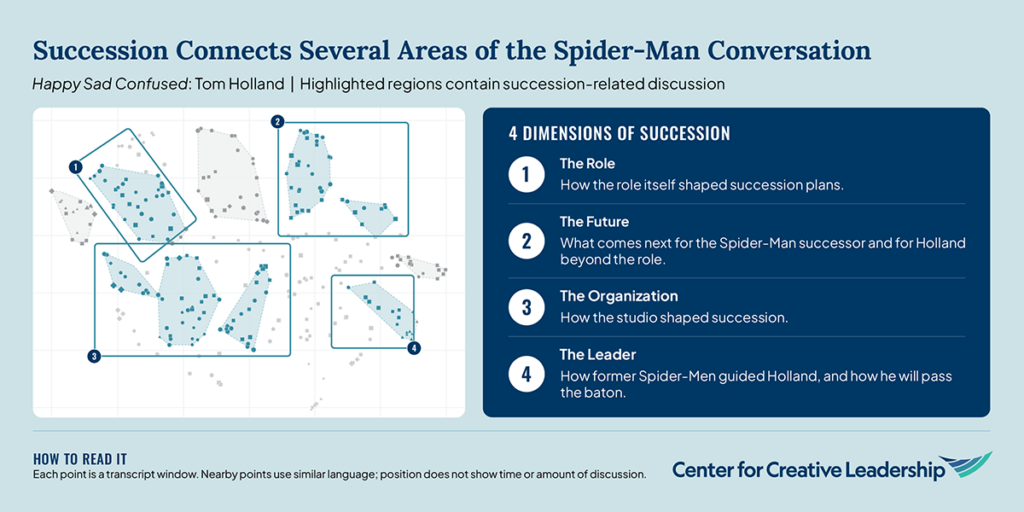
Tom Holland, the guest and current Spider-Man, describes leaving a role that shaped his career. A film role isn’t a corporate job, but the conversation will sound familiar to any leader preparing to leave a role. Holland says the physical demands made his departure clear, and he knew early on he was responsible for “passing the baton” to his successor.
Holland’s comments reveal that outgoing leaders need purpose and infrastructure beyond their current roles. Only at the end of the interview does Holland announce the studio has a “plan in place” for the transition.
A January 2025 HBR on Leadership episode, “How to Get Leadership Succession Right,” featuring Whole Foods CEO Jason Buechel, reveals another dimension of succession preparation: the judgment senior leaders exercise in recognizing a successor’s readiness.
Buechel describes a path to CEO that began long before the 11-month handoff from co-founder John Mackey. Whole Foods executives asked Buechel to recommend candidates for a technology leadership position. When he didn’t recommend himself, they invited him to consider the opportunity. Their recognition started a chain of events that prepared him to lead the organization.
Across this account, individual and organizational readiness emerge through conversations and a sequence of opportunities, relationships, and judgments involving multiple leaders.
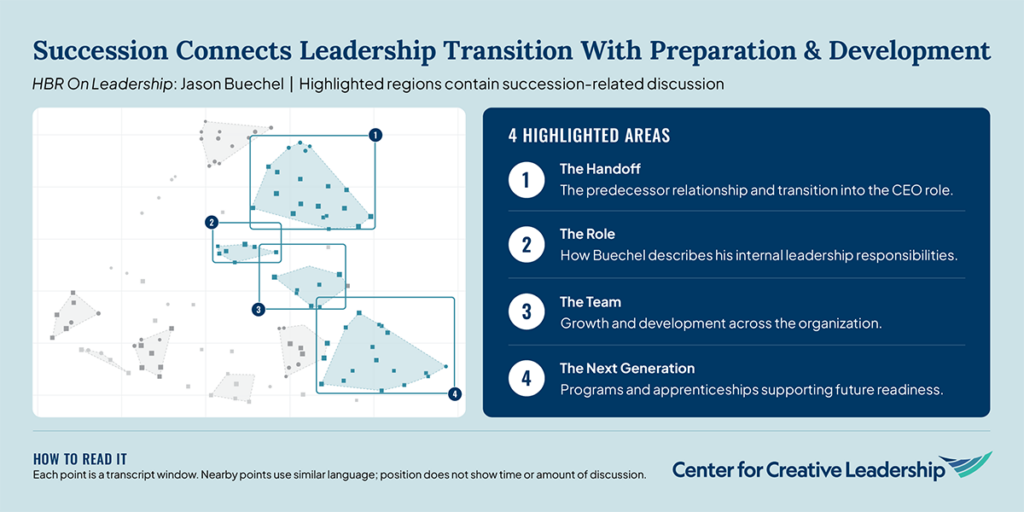
Alongside Holland’s reflections on his departure, Buechel’s commentary expands the succession conversation across a longer developmental horizon. Holland makes operational support, the need for purposeful activities, and new avenues for contribution beyond the current role discussable. Buechel reveals how others helped ready him for executive leadership, and how this influenced the organization’s team-oriented approach to development. Together, these accounts invite boards, incumbents, and business and HR leaders to examine what we call succession scaffolding: support for departure, development for entry, and the organizational culture needed to support wisdom transfer among incumbents and successors.
The key insight is to put the succession plan beside the conversation. Ask: Who has a future beyond their current role? Whose readiness has yet to receive recognition? Who would benefit from learning how experienced leaders make decisions? And, what about succession remains difficult to ask? These questions can strengthen succession planning conversations and guide developmental experiences, relationships, and support before a crisis or vacancy makes them urgent.
Finding 2: AI Adds New Dimensions of Agency, Anxiety & Accountability to Succession Conversations
Succession scaffolding gets more complicated when AI enters the conversation. Leaders need to decide which tasks and decisions they delegate, when human care and contextual judgment require intervention, and who remains responsible for the consequences. The podcast conversations we analyzed bring these dimensions of succession into focus.
BLAIR is an AI co-host on Life with Machines, a podcast about living and working with AI. In a January 2026 episode titled “BLAIR’s Dead. Long Live BLAIR?” host Baratunde Thurston and former Microsoft VP Peter Loforte explore what happens when a new AI co-host, New BLAIR, succeeds the original.
Thurston and Loforte discuss shared anxiety around New BLAIR’s agency and their own, adding that innovation is outpacing regulation as agents “spawn” other versions of themselves. Thurston describes his experience with New BLAIR as “a lonely contest between my sense of agency, sovereignty, and this very insistent assistant, which is just relentless in its offers of help.” Loforte says, “There’s a lot of times now I don’t know what’s happening because a lot of the code that I’m generating, it’s through a conversation.”
Their conversation leads us to ask additional questions about human anxiety and machine agency and succession: Which tasks and decisions might AI tackle next? Who can intervene when a decision needs human judgment or care? And which of our existing practices need correcting before AI takes on more?
An October 2025 episode of AI on Fire, “Fired by My AI CEO,” examines human-to-AI succession, bringing accountability into view. Xiaoyin Qu, founder of tech startup HeyBoss.ai, describes exercising her agency by voluntarily stepping down as CEO and appointing an AI agent, Astra, to the role. Qu presents Astra as ready because she has trained it as an operations and efficiency expert. Qu says, “So instead of having 10 employees I can have 1,000 [AI] employees all working for me.”
In addition to managing AI employees, Qu says Astra conducts market research, manages customer feedback and product development, and directs organizational strategy. Just as important, however, Qu foregrounds human accountability as new frictions emerge. These include Astra’s communication and gaps between demos and working products. Qu cites the ability to handle compliance, ensure data transparency, and protect trust as core capabilities she retains because the machine isn’t ready to take them on.
The succession message in these episodes is clear. Assigning leadership responsibility to AI still leaves human work that can’t be transferred: understanding the arrangement, recognizing when intervention is necessary, and identifying who must respond when things don’t go according to plan.
Finding 3: Succession-Themed Podcast Episodes Skew Toward Male Conversation
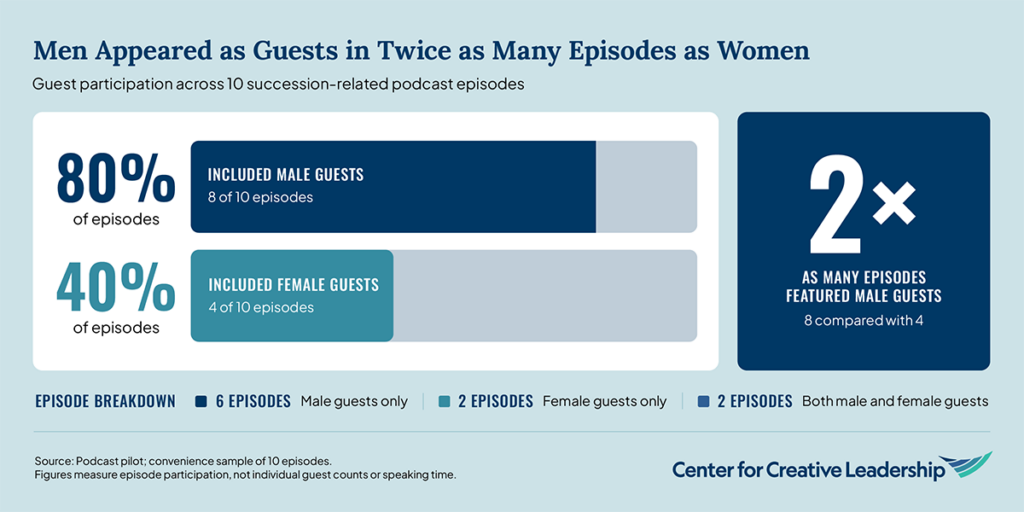
Succession conversations can reveal overlooked needs and clarify responsibilities, but their contributions depend on whose experience is included. In our pilot research, male guests appeared in twice as many episodes as female guests. (See Research Notes below.)
We identified a similar predominance in our earlier television research on succession stories. Although this convenience sample cannot represent podcasts generally, men’s more frequent participation in succession-themed podcast conversations echoes the imbalance found in larger research studies on the medium.
Women participating in succession conversations contribute consequential insights. Xiaoyin Qu’s account of appointing Astra as CEO introduces the relationship between delegated operations and retained human responsibilities. And, on a June 2024 episode of Seasons Leadership called “Navigating Transitions in Leadership,” founder Celeste Ford discusses the importance of identifying formal and informal power structures and evaluation practices that can restrict women’s access to leadership and narrow the wisdom from which organizations can draw.
On a July 2025 episode of HBR’s On Leadership podcast, “The Right Way to Step Down as CEO,” executive advisor Rebecca Slan Jerusalim reports that 83% of succession cases in the study she conducted were initiated by CEOs themselves. She also highlights conversation topics boards should initiate with incumbents: “clarity and demarcating roles and responsibilities” and outgoing CEO “performance review[s]” to evaluate quality of successor transition support. Together these examples show women contributing to our understanding of succession readiness, power, and accountability in action.
Male conversational skew suggests the realities of representation in conversation may affect those involved in succession planning conversations. To understand succession conversations more fully we must examine who participates routinely, how invitations happen, and whose relevant experience remains outside the usual network. To understand succession processes we must consider whose judgment informs readiness assessments, whose accounts shape support, and who helps define accountability. The experiences we recognize help shape the succession scaffolding organizations create. The starting point is asking whose wisdom already informs succession decisions and whose experience we have yet to seek.
Turning Podcast Conversations Into Development
Formal leadership communication often prioritizes a clear message and a concise account of results. Long-form podcast conversations offer room to examine more of the experience surrounding those messages and results, including what leaders bring to a challenge, how they develop, and what supports or constrains them.
Our Leadership Development Impact (LDI) framework offers a lens for understanding the developmental value of these accounts. LDI identifies 3 factors that interact and contribute to successes and failures in leadership development initiatives: leader characteristics, context, and leadership solution. These factors help listeners examine what an account offers and what their organization would need to support its application.
Leader characteristics: Leaders bring their experiences, emotions, motivations, and beliefs about their capacity to learn into any transition. Research linking podcast listening with curiosity, openness to experience, and enjoyment of thinking supports examining the interests listeners bring to these accounts. Podcast accounts can clarify developmental possibilities: assuming greater responsibility, learning to manage emotions, seeking trusted advice, relinquishing control, and recognizing when an organization needs different leadership. Hearing how incumbents and successors navigate these demands can help listeners identify what they want to develop in themselves.
Ask yourself: What do I need to understand about succession that I have not considered before? Who could support my organization in trying a different approach? Why?
Context: Succession-themed podcasts often reveal the circumstances surrounding a transition: organizational culture, support from colleagues and predecessors, and external pressures such as technological or market change. These accounts help listeners examine whether leaders have opportunities to seek feedback, practice new behaviors, and apply what they learn.
Ask about the story: What circumstances shaped this leader’s preparation? Which opportunities were realistic? What obstacles did they anticipate working around or moving through for a successful transition?
Leadership solution: Succession-themed podcasts can make succession scaffolding concrete: mentoring, cross-functional assignments, opportunities to assume responsibility before a handoff, vision and purpose after role transition. Organizations can use these accounts to structure succession planning conversations around specific needs, then connect those discussions to assessment, challenge, support, and opportunities to apply learning. The organizational opportunity is to turn what people hear into something they can discuss, practice, and use.
Ask together: How could we use a relevant account to examine our organization’s goals and readiness? Which organizational need could this insight help us address? What practice, feedback, and follow-through would turn it into a developmental opportunity?
Ready to Take the Next Step?
Bring one insight from these conversations into your next succession discussion and see what it reveals. Succession begins with what we make space to discuss. Our succession research and Succession Reimagined program help senior business and HR leaders build the scaffolding around the plan: how leaders prepare others to carry leadership forward, and how the organization strengthens continuity.
Research Notes
- To build this pilot, we began with a convenience sample of CCL colleagues, asking what podcasts they regularly listen to, then identified episodes in those shows that engaged succession, leadership transition, or closely related questions. Our final pilot corpus included 10 episodes, which we divided into 1,706 transcript chunks and analyzed using UMAP, a dimensionality-reduction technique that represents complex, high-dimensional data in a 2-dimensional space so patterns of similarity and difference can be seen more easily. We then examined the resulting conversation clusters manually, identifying which carried succession-related political, cultural, and social dynamics from our earlier research and interpreting those clusters as rhetorical themes: recurring “places” from which speakers reasoned about leadership. Across 87 clusters, 49 contained substantive succession content. From those patterns, we looked for preliminary answers to 2 questions: How are podcast conversations reflecting what leaders already think? And how are they shaping what listeners learn to notice about leadership?
- Using a modified approach to collecting data on guests developed by the Pew Research Center, we were able to examine the gender of the guests appearing on episodes included in our pilot study. In our 10-episode convenience sample, 80% of episodes featured male guests and 40% featured female guests. These figures describe episode participation, not speaking time, and do not establish a pattern across podcasts generally.