


A vice president sits at the head of a tense budget meeting. Stakes are high: 2 strategic initiatives competing for the same money and no clear answer. Everybody in the room is entrenched in their facts and arguments. The VP pauses, takes a breath, and stops himself from closing the door. Instead, he spots a protégé and whispers, “Come in. See how this meeting unfolds.” The protégé hesitates. The room reacts. The door stays open.
Other senior leaders look around questioningly. The protégé notices what the VP decides and how he navigates ambiguity. The VP does math in real-time, asks why often, and regulates emotion to balance competing priorities with commitment to shared direction.
Afterward, the VP and protégé debrief. They spend 10 minutes on the data and 50 minutes on the moment the VP leaned back, asked why a third time, and waited.
It’s the kind of judgment the protégé never saw in a job description or succession plan. And without moments like this one, the next generation of leaders loses more than a meeting. They lose the chance to see this kind of development is even possible. They can’t imagine it. They can’t ask for it. They can’t offer it to others.
What’s true for the VP and protégé turns out to be true for organizations at scale: Leadership wisdom depreciates if hoarded and compounds when shared.
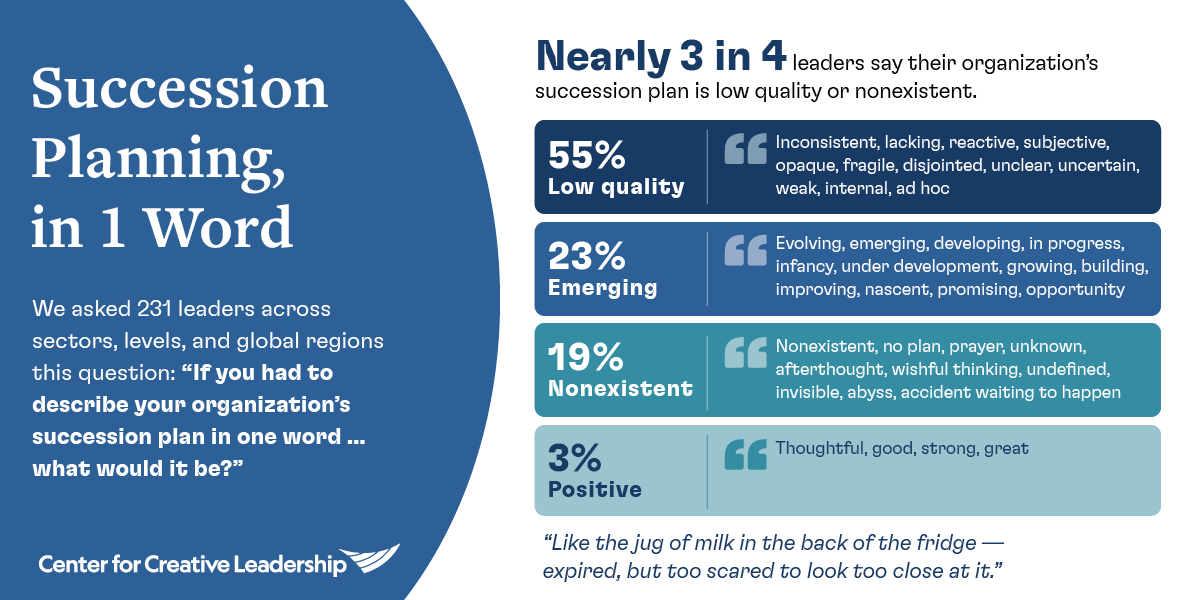
Our latest succession research confirms this principle. Organizations that treat succession as a reactive scramble lose the capacity to balance short and long term simultaneously. Because they haven’t done the advance work, they don’t know which roles cause the most disruption when vacant or how to execute the high-leverage actions that would address them. Organizations need to treat succession as a living system of leadership development, one that builds the wisdom infrastructure to find and grow the right leaders before they’re needed.
Knowledge Transfer vs. Wisdom Transfer: The Shift From Replacement to Readiness
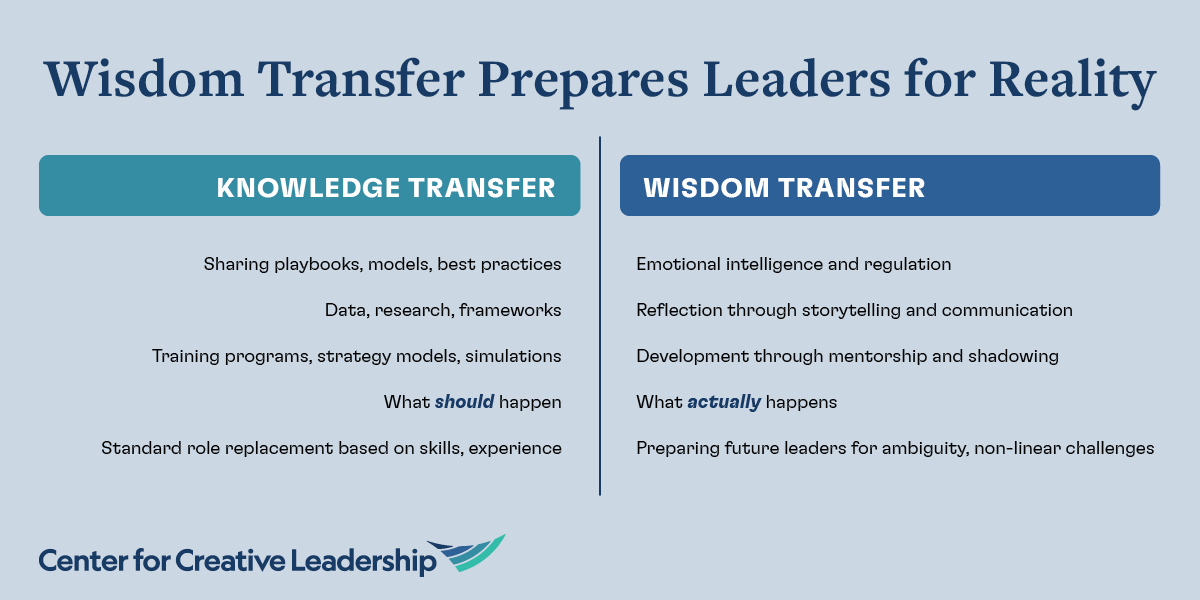
In our leadership succession research, many C-suite leaders report their organizations treat succession planning primarily as a tool for knowledge transfer, which represents the nuts and bolts of succession. It’s where organizations complete forms, deploy frameworks and data to make decisions, communicate best practices, perform standard role replacement based on job-related skills, and set expectations.
Knowledge transfer answers these types of questions:
- What do we do?
- How do we do it?
- Where is the information stored?
Knowledge transfer is necessary but insufficient for fueling the high-performing succession systems required in today’s landscape. Knowledge transfer prepares leaders for the ideal scenario, not the real one. Indeed, C-suite leaders tell us the most critical moments of leadership happen outside the ideal scenario.
What happens when your top-level leaders depart unexpectedly? What happens when external circumstances cause a shock? What do leaders do in the inevitable moments when their playbooks run out and they enter situations for which they haven’t been formally trained? This is where leadership wisdom becomes essential.
Leadership wisdom is the ability to interpret a given context, anticipate consequences, and consistently exercise discernment in the face of complexity. Wisdom transfer is the intentional sharing of that judgment, experience, and discernment from one generation of leaders to the next — helping future leaders navigate ambiguity and complexity.
Our research reveals effective leadership transitions occur in organizations that make the transfer of wisdom a central focus of succession infrastructure. Start by answering these types of questions:
- Where is our organization’s wisdom living, and is it flowing?
- What is this moment requiring of us that process alone can’t answer?
- What, besides a person, leaves when a senior leader departs the organization?
Wisdom transfer reframes succession from a static process into a strategic mindset. When leaders recognize the importance of wisdom transfer in succession, they begin to view succession less as a checklist and more as one of their greatest leadership opportunities. And as illustrated in our opening story, wisdom transfer often starts with something as simple as a personal invitation: “Come with me so I can show you how this really works.”
Succession Infrastructure: Creating Avenues for Wisdom Transfer
If wisdom transfer is the answer, then the question is how to bring this concept to life in your organization’s succession processes. The journey begins by taking a step back to examine the entire system across multiple time horizons. Below are 4 core elements of wisdom transfer, each functioning as a structural pillar in your modern succession system.
1. Witnessing Decisions in Real-Time
Succession, at its best, is a carefully crafted journey in leadership development. And no part of that journey is more formative than being present when consequential decisions are made. Emerging leaders need regular opportunities to observe how things actually happen at leadership levels other than their own.
The goals of such opportunities are to develop the capacity to sense what’s happening beneath the surface of a conversation, feel the ground shifting, and respond with discernment rather than procedure. Organizational systems do this best by creating development journeys that promote interpretation and integration of observations into emerging leaders’ own thinking and acting. These experiences afford leaders greater awareness of essential capabilities that are required for the next level up, regardless of whether they appear in the job description. These observations become some of the most powerful forms of wisdom transfer because emerging leaders witness judgment in action.
Your move: Map the highest stakes decision-making moments for leaders in your organization and ask who is in the room, and who should be.
2. Communicating Continuity Through Leadership Transition
Critical succession moments arrive without announcement. They happen in a room full of people who stopped believing, or a culture in transition between what it was and what it must become. Navigating these moments requires leaders who can continually orient themselves and their organizations within shifting terrain.
One proven practice revealed in our research is the deliberate assembly of a wisdom council: a group mapped to real influence and institutional memory, where every major function has either its leader or their most valued direct report present. This creates a living network capable of asking collectively: Who are we, who are we becoming, and what must we carry forward?
Organizations that cannot answer these questions during a leadership transition face a strategic risk: They lose the ability to distinguish what must be preserved from what must be released. The result is either calcification around the wrong strengths or abandonment of the ones that made them viable in the first place. The answers live in people and surface when wise leaders read the room and state what everyone is feeling but cannot yet articulate.
Your move: Before your next leadership transition, identify who holds the memory of why your organization is what it is, and confirm they’re in the room.
3. Fostering Developmental Relationships
Wisdom grows fastest between people who trust each other enough to be honest, and developmental relationships are often the primary vehicle for wisdom transfer in organizations. It’s precisely here that emerging leaders receive their most valuable guidance before pursuing and assuming new roles.
Judgment is the clearest example. It’s abstract, difficult to teach, and absolutely essential to transfer. Developmental relationships can create conditions that improve judgment when seasoned leaders walk through hypothetical scenarios, articulate their reasoning, compare thought processes, and discuss factors they weigh in consequential moments.
Our research surfaced relationships between colleagues and mentors that sustained themselves across decades, long after formal roles ended. This suggests wisdom transferred in relationships doesn’t expire when someone exits a role. It compounds.
Your move: Identify the developmental relationships already alive in your organization and ask whether you’re protecting them or letting them disappear when roles change.
4. Mapping Influence Networks
Organizational wisdom transfer doesn’t follow the organizational chart. It lives at nodes where leaders are most connected to multiple stakeholders and perspectives. Network science consistently confirms what our own bibliometric research reveals: The most influential carriers of wisdom and institutional memory are often found at the edges and bridges of an organization.
Three network properties matter most for succession. First is status, which reflects how deeply and broadly a leader has built connection at work. Wisdom-rich leaders are those embedded across multiple influence circles simultaneously, and their value to succession is often invisible until they leave.
Second is spanning boundaries to carry perspective across functions, generations, and organizational lines. Boundary spanners set agendas and control the flow of information, often leading without formal authority. Because their influence is relational rather than positional, they may not appear in succession plans, which is why organizations struggle to explain why some ideas stall and others gain momentum.
Third is coalition capacity, the ability to build trust across differences and hold competing perspectives in productive tension. Organizations that lose this capacity during leadership transitions lose their ability to attract and grow the next generation of leaders.
Our research confirms that tomorrow’s workforce is a planetary network, organizational resilience is built by those who have already reimagined survival in other contexts, and your next breakthrough leader might be speaking a language you don’t yet understand. Influence network mapping is how you find them before you need them.
Your move: Map your organization’s influence network and ask where wisdom is concentrated, where it is flowing, and who carries it that your organizational chart doesn’t show.
Making Wisdom Transfer a Leadership Development Priority
The knowledge that got us here may not be sufficient for what comes next. We’re living through a moment when the symbols of leadership development can be generated infinitely and for free. Competency frameworks, feedback templates, succession documents can all be generated by AI in seconds.
What cannot be prompted is the labor of wisdom. The VP who opens the door. The mentor who stays connected decades later. The council assembled to hold organizational memory through a difficult transition. These things cost time, presence, and energy. Those costs are precisely what make wisdom transfer valuable.
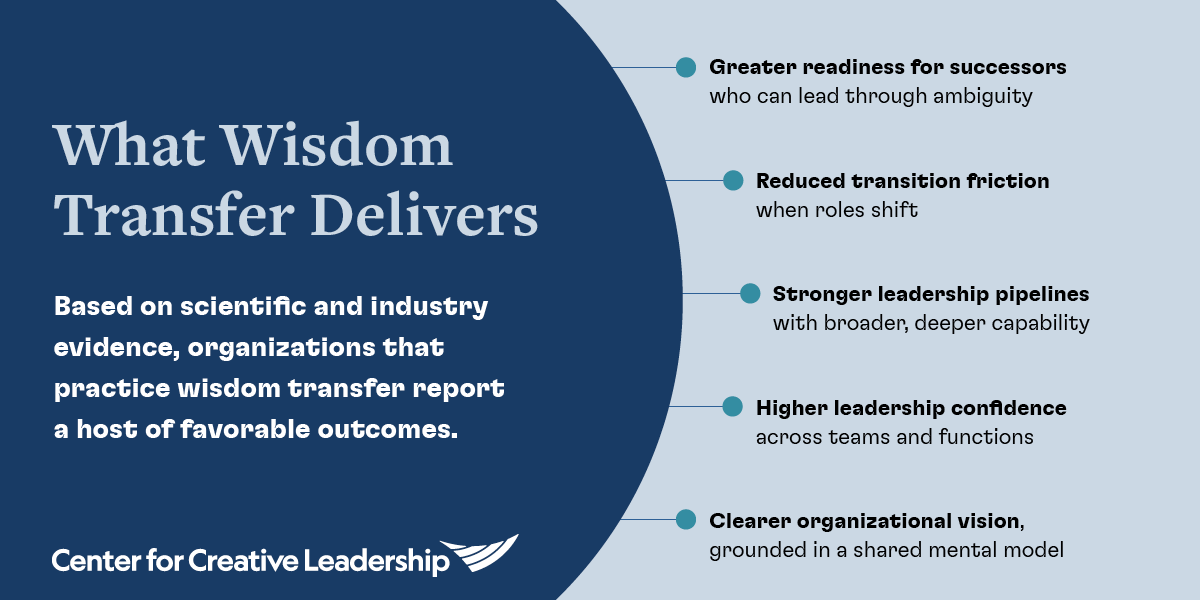
We’ve spent years studying what separates organizations that navigate leadership transitions successfully from those that don’t. Our research led to a critical conclusion: Succession plans fail when wisdom stops moving through the transition. The judgment, the instincts, the hard-won perspective that only comes from years of experience leading through reality and complexity. This is what wisdom transfer is designed to restore.
You sit at the center of this shift in your development decisions. You influence the systems, programs, and expectations that shape leadership behavior. You know where the wisdom in your organization lives, where it’s flowing, and where it isn’t. When you lead this work, succession planning transforms a risk-mitigation strategy into a regenerative leadership system that grows wiser with every transition.
You have the power to build that system. And you don’t have to build it alone.
The Future of Succession Is Wisdom‑Powered
Organizations that thrive in the next year, decade, and century will be the ones that treat leadership wisdom as their most valuable asset, knowing it retains its worth only through deliberate transference. That work cannot be automated, but it can be built.
Wisdom transfer is how you move from paper successors to prepared leaders. It’s how you build an organization that knows how to keep the lights on and where to shine them next. And it starts with something as simple as an open door. The organizations that commit to this will find the leaders they’re looking for. And those leaders will be ready.
Ready to Take the Next Step?
Succession works best when leadership is transferred, not just assigned. Learn how our new Succession Reimagined program helps you build it.