


You’ve felt it: Some colleagues recharge you while others leave you depleted. Leaders often shrug this off, dismissing the impact as trivial. But our research suggests this assumption is costing you and your team more than you think.
Here’s what our insights show: a single negative relational energy tie cancels out 4 positive relational energy ties. Before we unpack what this means for leaders and its impact on creating a positive work environment, let’s define what “relational energy” is.
What Is Relational Energy?
Energy is an important individual resource. Personal energy can be conceptualized as physical energy (the objective energy that powers our body and comes from food, exercise, and sleep) and emotional energy (the subjective, affect-based energy related to emotional activation). Relational energy isn’t a third type; instead it represents the idea that social interactions are a source of positive or negative emotional energy. In essence, relational energy is the energy you get from others at work — it can boost your motivation and help you get more done or deplete you and negatively impact your work.
Past research shows that relational energy has an impact even after taking into account workplace social support and the quality of the relationship between a leader and team member. Prior work shows that positive relational energy with leaders is related to higher job engagement and better job performance. In workplace social networks research, de-energizing relational ties are related to reduced thriving, lower motivation, and increased turnover.
Relational Energy: What It’s Not
Let’s clarify 2 key distinctions:
First, relational energy isn’t about the intrinsic emotional value of the topic — it’s about how people interact while discussing it. Two people can address a topic that may be perceived as negative, such as budget cuts, but still keep a high level of energy during the conversation. Similarly, 2 people can discuss a topic that may be perceived as positive, such as winning new business, but do so in a way that depletes energy.
Second, relational energy is distinct from employee voice, which is when employees speak up to leaders with ideas, concerns, suggestions, and process improvements. Employee voice is a proactive behavior motivated by a desire to improve the organization. Research shows that employee voice is positively related to work process improvements, organizational innovation and creativity, greater organizational learning, and better decision making.
Unfortunately, employee voice isn’t always well received, particularly by certain leaders. Past research shows that leaders with low self-efficacy (such as a low perceived ability to meet the high competence expectations associated with a leadership role) are much less receptive to employee voice. They’re more likely to negatively evaluate employees who speak up and are less likely to solicit input from employees due to their own ego defensiveness. Ironically, our research on what helps employees feel “listened to” found that being more receptive to employee voice would likely make these individuals better leaders.
Although it may be tempting to dismiss employees who speak up as having “negative” relational energy, this misconstrues what relational energy really means. We encourage leaders to carefully rethink such judgments and reflect on whether these views are an ego defense mechanism.
Our Research on Relational Energy: What We Did & What We Found
In our Leadership at the Peak program, we collect data in our Team Vantage™ assessment. Team leaders and members rate how interactions with each person “typically affect” their energy level. This provides us with round-robin ratings of relational energy, which we analyze by rater source and link to team outcomes. We’ve collected data from more than 600 teams of 4–16 members each (an average of 7), totaling more than 34,000 relational ties.
First, the good news. More than 91% of relational ties were rated as either neutral or energizing. In contrast, de-energizing ties were rare — only 9% of all possible relationships.
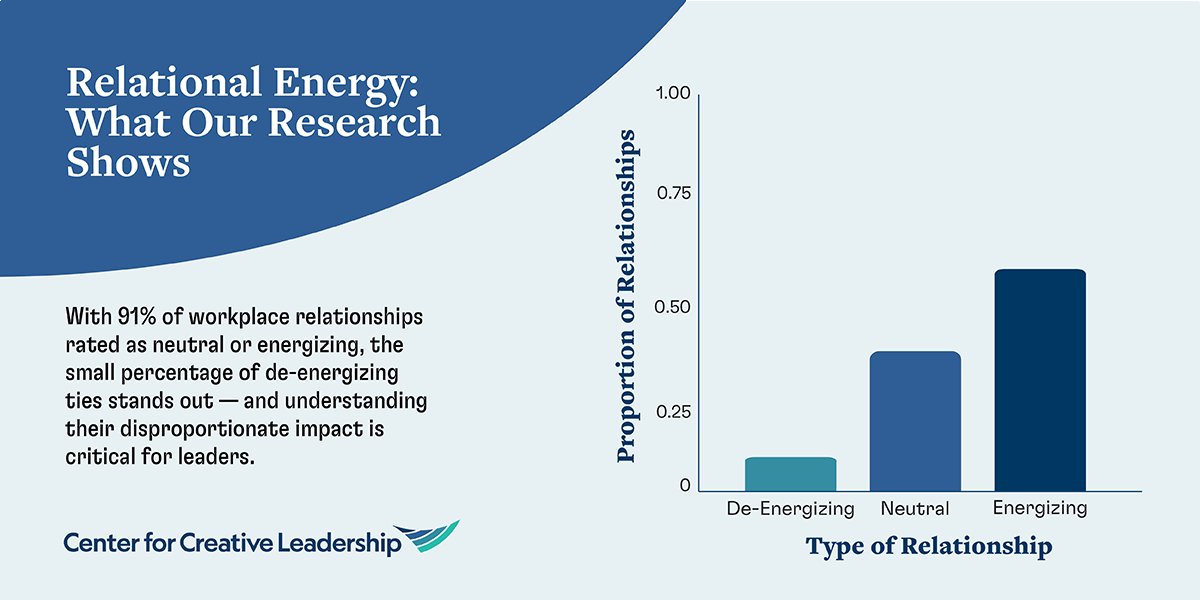
Some teams had zero de-energizing ties, while others had more than a third of their relationships that drained energy. Overall, the proportion of de-energizing ties within a team ranged from 0% to 38%.
Now, the bad news. Those de-energizing ties tend to have outsized effects. Across the measures of team effectiveness that we examined, the standout finding is striking: removing a single negative energy tie is equivalent to adding 4 positive energy ties. (This is based on comparing the predictive effects of the total number of de-energizing and energizing ties within a team, then calculating the ratio of these 2 values.)
For team leaders aiming to foster a positive work environment, this underscores the significant challenge of counteracting the impact of even one negative energy tie in the team. That’s why a crucial metric is the team’s ratio of energizing to de-energizing relational ties.
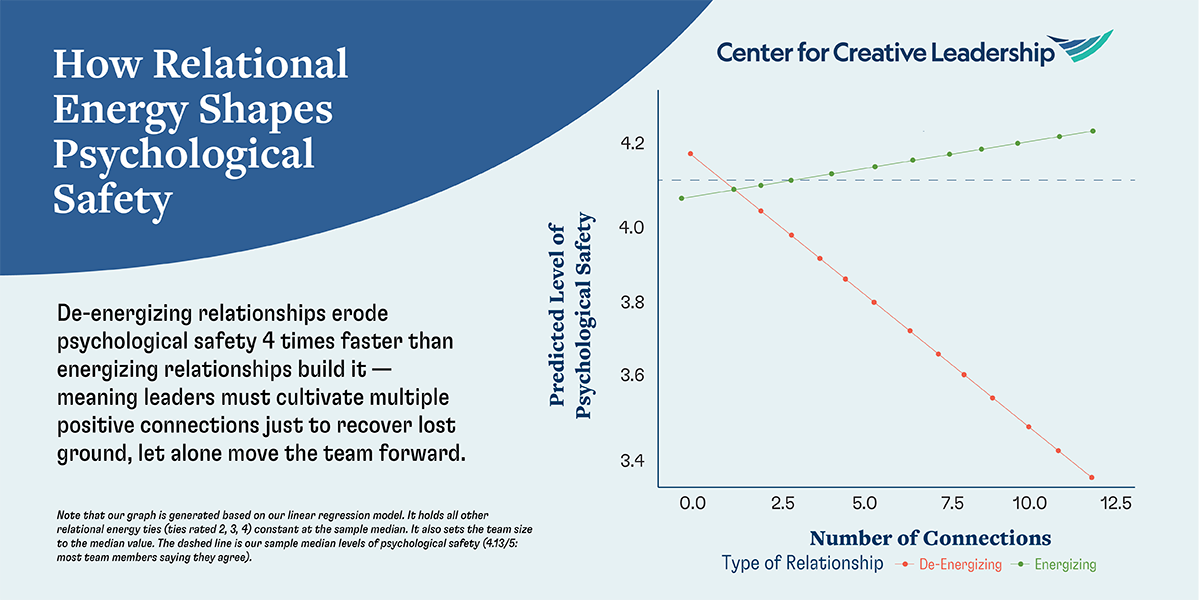
Overall, our results reveal that a team’s relational energy is linked to multiple team outcomes. For example, when predicting psychological safety, having more strongly de-energizing relationships affects the team about 4 times more than having more strongly energizing ties. Put another way, as a team leader you would need to cultivate 4 strongly energizing connections among team members to neutralize the impact of one strongly de-energizing relationship — and that only brings the team back to neutral. To propel the team toward positive energy, you’d need to foster even more strongly energizing relationships.
You might wonder whether the impact of negative relational energy depends on someone’s role. Unfortunately, it does, and strongly. A negative energy tie with a team leader has 3 times more impact on team outcomes like psychological safety than a negative energy tie with a team member.
Recognizing Negative Relational Energy
Before we get to practical advice for leaders, let’s identify what negative relational energy looks like. And, yes, there is some agreement about who brings the negative energy to the team. Below are some behaviors and attitudes that consistently drain the team’s energy and enthusiasm.
Some red flags are:
- Frequent complaining, with a focus on problems rather than solutions
- Viewing most situations in a negative light — win-lose or lose-lose scenarios rather than win-win scenarios
- Stirring up conflict by escalating minor issues and drawing others into the fray
- Often critiquing or blaming others, without taking personal accountability
- Showing little empathy for others’ needs, feelings, or situations
- Unnecessarily taking up significant time, attention, and energy to meet excessive demands
Given this list, you might wonder (as we often do) why anyone would choose to dwell in this negative energy space. While we can’t fully answer that, it may be because even though it doesn’t feel good, it may feel comfortable because it’s familiar. People often prefer comfort over the discomfort that comes with change.
Managing Energy at Work
Tips for Team Leaders
Frustration with others is one of the top leadership challenges, and managing negative relational energy on your team can be difficult. It’s important to be aware of the positive and negative impacts among your team members and look for significant changes in energy dynamics when certain team members are present or absent.
Pay attention to changes in conversational contributions; collaboration rates among team members; and conflict, disengagement, and team morale. Be wary of the inclination to downplay or dismiss the impact of negative relational energy, and realize that it takes significant effort and valuable emotional energy for team members to recover from negative relational interactions.
Although it’s good to have compassion for team members who bring negative relational energy, you also have a responsibility to limit their ability to negatively impact the team and its outcomes. Choosing to do nothing signals acceptance of the behavior.
Here are 3 strategies you can use:
- Set clear expectations for behavior. Clearly communicate and model the positive, solution-focused behavior and attitudes you expect. Address behavior that doesn’t align with these expectations.
- Offer support and development. In addition to giving feedback, provide opportunities for team members to develop new skills and strategies for managing problematic behavior. This may include training, mentoring, or coaching. If a team member shows no interest in changing their behavior, this is a clear signal about their self-focused intentions.
- Take firm action when needed. These decisions are never easy, but if there’s no progress despite coaching and support, protecting the team becomes the priority. Consider structural changes (such as reassignment to a different role or limiting group interactions) to safeguard team psychological safety while continuing to work with the individual.
We recognize that one of the reasons negative relational energy can be so challenging to address is because it’s not clear bad behavior like sexism, racism, or abuse. Instead, it’s like the small, steady drip of acidic water on a rock. Over time, those tiny drops create fissures that can fracture a team and drive valuable members away.
Tips for Team Members
We often have no choice about who we work with, but we can influence how we work with others. If you have an energy vampire dynamic with someone on your team, here are actions you can take (no garlic required):
- Maintain your own positive energy. Keep an upbeat attitude and focus on solutions rather than problems to avoid getting drawn into negativity. When possible, choose to work with teammates who are an energetic match with you.
- Practice self-care and identify practices that recharge you. Ensure you’re mindful of your physical, mental, and emotional wellbeing and regularly engage in practices that replenish your energy at home (time in nature, exercise, hobbies) and at work (conversations with high-energy teammates).
- Focus your time. Managing energy at work includes managing your time effectively. If you must interact with negative relational energy, keep interactions brief. Refuse to spend time listening to complaints, blame, or unnecessary drama. When possible, communicate in ways that work best for you, like email, rather than synchronous interactions. Schedule meetings for when your energy is highest.
- Set personal boundaries. Be clear about what behaviors you will not tolerate, and communicate those boundaries directly. Be assertive in holding your boundaries and use “I” statements to explain the impact of someone’s behavior or attitudes on you and your work. If necessary, bring your team leader into the mix.
- Reflect and learn. Rather than ruminating about negative interactions, reflect on them productively to see what you can improve. Try new behaviors such as redirecting conversations to be more productive, seeking support from positive relational energy peers, and finding the humor in such interactions. The strategies you learn at work can likely be useful in your personal life, too. Recognize that the only things you have control over are your own behaviors and attitudes.
Highlighting Relational Energy Awareness
Our recommendations focus on managing negative, rather than positive, relational energy. This is intentional, given the outsized impact it has in teams.
We hope this work raises awareness of relational energy and inspires a kind of energy consciousness: a habit of noticing what or who energizes or depletes you.
Above all, relational energy is authentic. This isn’t about faking positivity or forcing team members to display energy that they don’t feel. To do so would be merely performative (not to mention exhausting) and requires surface acting, which is related to higher stress and lower job satisfaction.
We’ve all experienced the impact of relational energy at work. Many of us understand it intuitively, even if it’s hard to explain. We hope that our research can help you name and claim your experiences and provide legitimacy for them. These insights and suggestions can help you recognize — and better manage — the profound impact relational energy has on your workplace experience.
Ready to Take the Next Step?
Help your team build ties that foster collaboration and positive energy. We can partner with you for team development designed to give teams and their leaders the skills to succeed together.