



Leaders can generate more answers in less time than ever before. What’s becoming harder is knowing which answer deserves action, how it impacts others, and where accountability lies once a decision is made.
More answers don’t ensure greater knowledge.
Organizations face conditions where expertise alone is insufficient. Leaders must simultaneously navigate ambiguity, competing priorities, and the need to lead across many boundaries. Under those conditions, leadership wisdom becomes increasingly consequential, not as a vague aspirational virtue, but as a learnable and essential capability. Without it, leaders default to speed or certainty as substitutes, and neither withstands real pressure.
Developing wisdom strengthens individual leaders and shapes how effectively teams and organizations respond when conditions are uncertain and urgent.
Our emerging perspective on leadership wisdom begins with the premise that it isn’t reserved for a select few, nor is it separate from the practice of leadership. Wisdom is a leadership capability that leaders can understand, build, and put to work — starting with what it’s often associated with: judgment and decision-making.
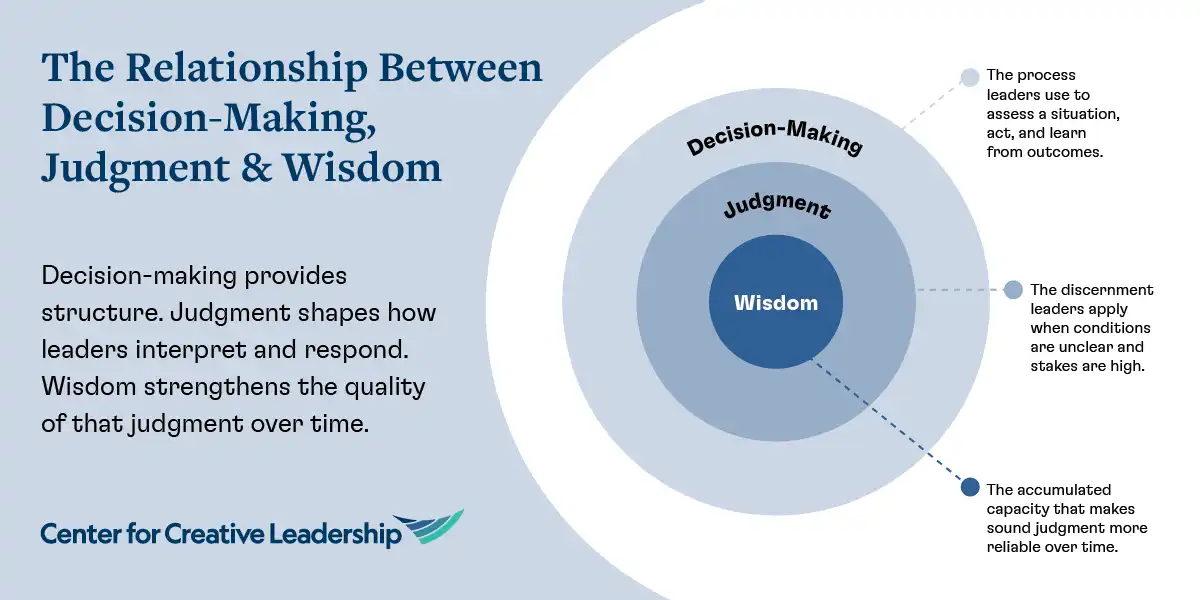
The Relationship Between Decision-Making, Judgment & Wisdom for Leaders
Decision-making, judgment, and wisdom each play a distinct role in how leaders navigate complexity.
Decision-making is the process leaders use to work through a challenge and reach a conclusion. Judgment is the discernment leaders apply within that process, particularly when conditions are ambiguous or stakes are high. Wisdom is what makes that judgment sounder and more reliable over time.
AI is already reshaping one part of that structure.
But AI can’t simply apply leadership judgment and wisdom. It has no way to reflect on a past decision and use what was learned, or empathize with the impact the decision may have on others and factor that into how to proceed. Nor can it engage in the collective sensemaking that infuses raw information with deeper meaning.
AI can expand analysis and surface possibilities. Leadership wisdom determines how those possibilities are interpreted, weighed, and applied in context. When AI can make answers abundant, wisdom becomes the scarce resource to discern which answers are most relevant.
Wise leaders and teams demonstrate the capability and capacity to discern complex challenges, apply knowledge and insights gained from their experiences, and engage one another in mutual sensemaking to arrive at sound judgments that create pathways for progress and benefit the greater good.
The Urgency of Wisdom in Leadership
Several forces are converging to make the need for wisdom more urgent. AI is changing what’s available to leaders when making decisions. At the same time, the decisions themselves are getting harder: more interacting variables, less clear-cut tradeoffs, higher stakes, and less time for consideration. Leaders are being asked to move fast in conditions where fast and wise don’t naturally go together.
Add a workforce with more generations in it than ever before, each carrying a different relationship to experience, technology, and risk, and the challenge multiplies.
Individual leaders can exercise judgment well. What’s harder is getting it right consistently across an organization, not just among a few people at the top.
One place this shows up clearly is succession planning. Our research points to wisdom transfer as one of the most overlooked levers in getting leadership transitions right: The loss of an outgoing leader’s wisdom can cost an organization more than the loss of their role.
What Leadership Wisdom Encompasses
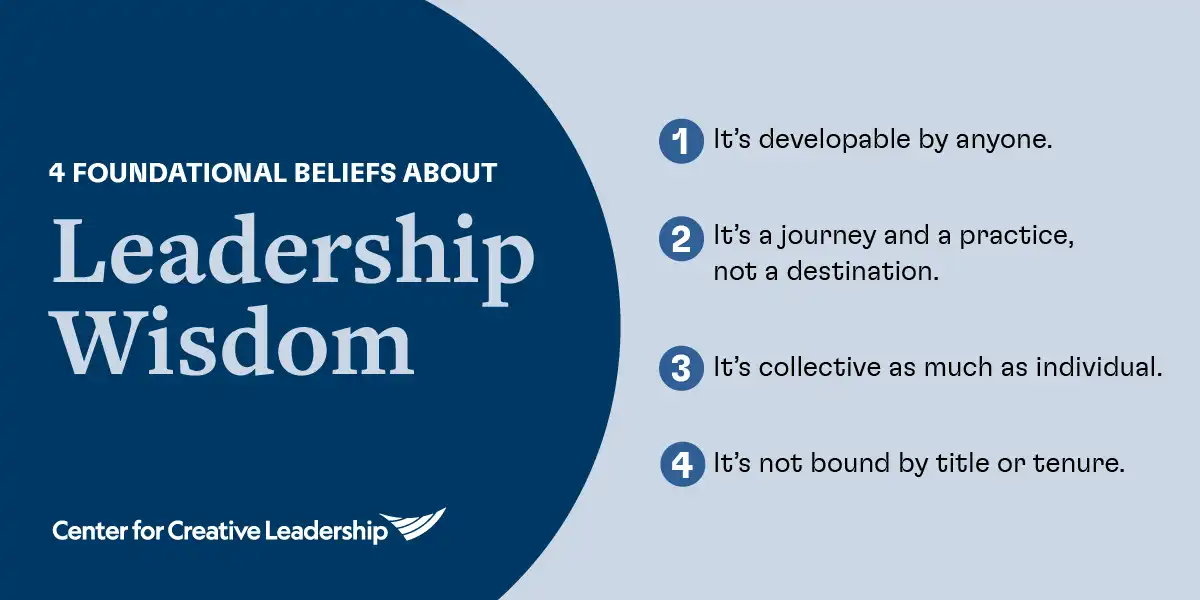
Wisdom isn’t reserved for the most senior person, and it isn’t something you either have or don’t. Our research and experience working with global organizations suggest several important characteristics of leadership wisdom:
- It’s developable by anyone. Wisdom must be sought and earned, not bestowed. There are habits that build it, and the leaders who put in the work see it compound.
- It’s a journey and a practice, not a destination. There’s no summit to reach. Wisdom is dynamic and regenerative. Leaders should ask themselves how they can become 2% wiser each year. Small, consistent steps add up to transformational growth across a career.
- It’s collective as much as individual. Wisdom is shaped by lived experience, but just as much by the people a leader engages with, learns from, and is challenged by. The hardest calls are rarely made well in isolation.
- It’s not bound by title or tenure. Wisdom isn’t attached to a degree, title, or career stage. It transcends generational boundaries. It can be mined from the past, applied in the present, and directed toward the future.
How Wisdom in Leaders Is Developed
Like creativity and other complex human qualities, leadership wisdom is more nurtured than taught. You create conditions that promote development, support individual and collective wisdom as it forms, and provide guidance along the way.
At the heart of developing leadership wisdom is a 3-pronged approach:
- Wisdom capability consists of the practices, habits, and tools that convert knowledge and experience into crystallized intelligence to support wise action.
- Wisdom potential is the richness and diversity of experiences, relationships, and perspectives leaders draw from. The development work here involves surfacing what’s already there, learning to reflect on it and extract its meaning, and then intentionally seeking out what’s missing.
- Wisdom capacity is a leader’s expanding ability to take in more, integrate more, and produce more from what they’ve built. Our emerging research suggests a meaningful relationship between a leader’s stage of vertical development and their ability to demonstrate wisdom-linked behaviors, opening powerful possibilities for accelerating wisdom development.
These dimensions reinforce one another over time. Experience alone doesn’t create wisdom. Leaders also need reflection, feedback, perspective-taking, and developmental challenge to translate experience into discernment.
The Difference Leadership Wisdom Delivers
Wisdom creates meaningful, lasting impact, from the individual leader to society at large.
For individuals, wisdom compounds. Richer insight, stronger judgment, and a clearer sense of purpose accumulate decision by decision.
For teams, shared wisdom creates collective judgment that no individual could reach alone and enables more effective navigation of complex challenges. This is especially important for global and cross-functional teams, where diverse perspectives must be leveraged to arrive at optimal, long-term outcomes.
For organizations, wisdom at scale supports cultures of psychological safety, dialogue, and continuous renewal, conditions that sustain high performance. Wise organizations elevate collective wisdom to institutional wisdom and leverage it to lead through crisis and disruption with confidence and competence.
For the greater good, wisdom isn’t a panacea for the persistent challenges leaders face. But it enables societies to address challenges with the maturity and momentum needed for genuine progress.
The future will not reward leaders who simply know more, move faster, or sound more certain. It will reward leaders who can discern what matters, make sense of complexity with others, and exercise sound judgment when the stakes are high.
Ready to Take the Next Step?
Watch our webinar, How AI Is Changing Decision-Making, where we explore why leaders are turning to AI before they turn to each other, and what that shift costs collective judgment. For emerging research on AI, wisdom, and more, sign up for our newsletters.