
5 Keys to an Effective Leadership Development Strategy
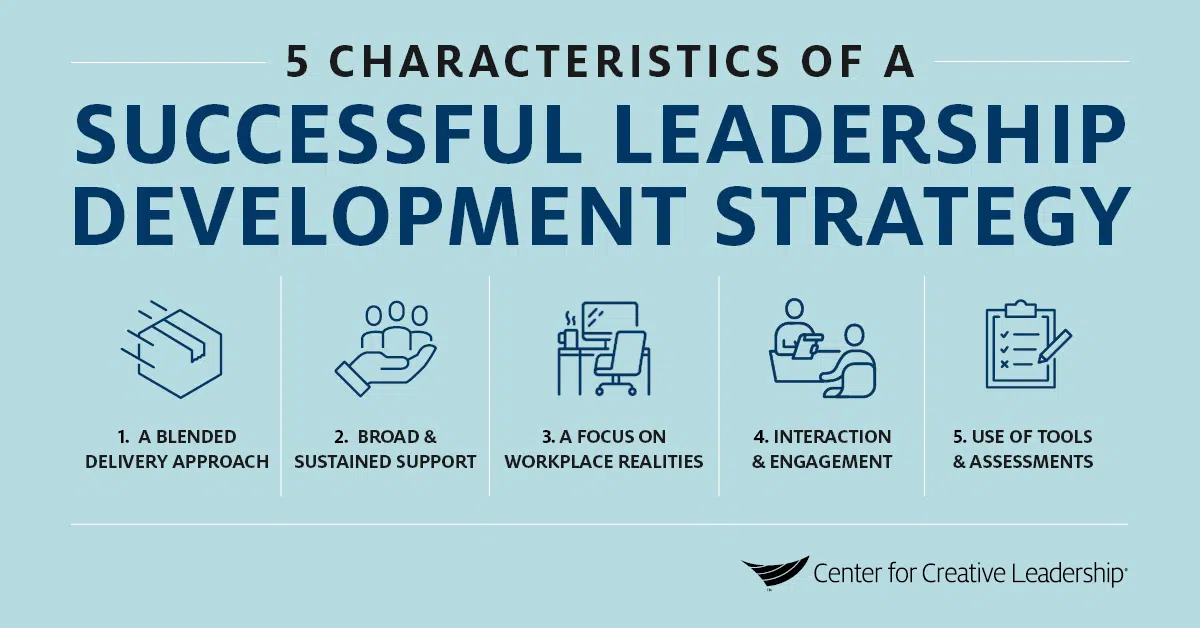
1. A blended delivery approach.
It’s time to say goodbye to the one-size-fits-all model to training.
The executives in our study reported that the most successful leadership development initiatives involve a blended approach that reflects the organization’s unique culture and business needs.
Respondents defined “blended” broadly and think about it from 2 perspectives:
- Blending modalities, such as combining in-person delivery with online leadership training, either live or asynchronously, gives leaders greater flexibility and choice in how they learn.
- Blending formal programs with informal learning, including access to webinars, on-demand tools, self-paced videos, leadership workshops, coaching and mentoring, etc., reinforces learning and makes it easier to accommodate and absorb.
To help leaders navigate these expanded development choices in a thoughtful and systematic way, organizations are providing guidance on what capabilities and leadership competencies are most important at each point in the typical career continuum.
As one Chief Talent Officer told us, “We let anybody take anything, and we have learning maps. Our belief is that if you tell the leader what they need to be successful, then it will be upon them to use resources. It places accountability on the learner.”
Access Our Webinar!
Watch our webinar, Aligning Your Development Strategy: The Right People, Capabilities & Delivery MixThe Challenges of Scaling Leadership Training, to learn about leadership development approaches that increase impact without increasing complexity or cost.
2. Broad and sustained support.
Often, new training offerings are announced with great fanfare, but quickly fade away and become the “flavor of the moment.”
There is no consistency, no sustained support, and no follow-through from month to month or year to year, which can drain people, send the wrong message, and undermine faith in the investment in L&D — all the opposite of an effective leadership development strategy.
But increasingly, senior leaders see an effective leadership development strategy as a point of differentiation that helps them improve employee engagement and retention, retain talent, bring their corporate strategy to life, and position their organizations to weather unpredictable disruptions, leading through uncertainty in the marketplace and the economy.
As a result, HR executives are focused on building top-down, organization-wide support for learning across all levels — making it a part of each leader’s job and creating an overall culture of learning.
A comprehensive, all-access pass to leadership development training content can be very helpful in providing turnkey, effective leadership strategy and support, enabling L&D and HR teams to scale learning across the organization.
At the same time, prioritizing executive leadership programs and coaching can offer more personalized development for senior leaders, who are essential in executing strategy, motivating and inspiring others, and modeling effective leadership behaviors.
3. A focus on workplace realities.
The leaders we surveyed say the most effective leadership development initiatives link learning to real-world challenges and opportunities. After all, growth most often occurs when on-the-job experiences are at the center of talent development.
Of course, organizations must do this while also recognizing the real struggles their teams face. Burned-out, stretched-thin managers don’t have much time or energy for learning & development — or even leading effectively — if their focus has been on survival. Helping employees manage their work-life conflicts was important even before the pandemic, and it continues to be critical.
As always, though, the most successful and effective leadership development initiatives also bring leadership theory to life. When leaders understand how their work supports the overarching success of the business and connect to the organization’s purpose, their learning becomes more relevant.
That’s especially true if workplace-linked development is reinforced over time with networking, peer learning, ample boss support, and coaching and mentoring, particularly for new leaders.
4. Interaction and engagement.
Today’s HR teams are pushing development well beyond static lectures, because successful leadership development strategies ensure that learning is active, not passive.
As one senior HR leader told us, “Regardless of whether it’s through a screen or in person, it’s not going to be effective if you can’t stop and ask questions. Interaction is very important.”
So organizations are bringing learning to life with interactivity, gamification, Q&A sessions, and other techniques that keep learners interested and engaged. As a result, important ideas are more likely to “break through” and capture each leader’s attention, leading to sustained behavior changes.
Experientials and simulations, for example, can make learning “stickier” and therefore more likely to produce lasting change. They can shift a leader’s mindset and open them up to new possibilities and to more effective ways of leading.
At CCL, our core leadership programs have long been lauded for their personalized, hands-on learning opportunities, particularly when delivered in-person. But we’ve also found that online leadership development offers unexpected benefits when the program is deliberately designed to foster authentic connections and deliver vibrant, engaging experiences.
5. Use of tools and assessments.
Learning to lead is an intensely personal experience. That’s why it’s no surprise that our surveys found that HR teams are building successful leadership development strategies starting with specific, tailored guidance for each leader’s personal development journey using individualized leadership assessments.
To model this best practice, HR and L&D departments identify the leadership skills their organizations need for current and future success. And they use 360-degree feedback assessment data to benchmark competencies and help each leader become more self-aware, with an understanding of strengths and development needs.
This assessment-based perspective provides an important focal point for leadership development. Leaders have a clear understanding of what their organization needs, how their performance compares to their peers, and which improvements they need to make to support their organization’s success. They then can build a personalized development roadmap for their own leadership journey.
This is among the 360 degree feedback best practices for linking talent and business strategies, and the most savvy organizations consider this foundational in an effective leadership development strategy.
In closing, given these 5 characteristics that emerged, consider your company’s approach. How is your organization thinking about its L&D investments and leadership development strategies?
Ready to Take the Next Step?
We can help you craft a successful leadership development strategy for your organization. Partner with us for customized leadership training, or take advantage of our many leadership training tools and materials to bring our proven content in-house to leaders at all levels of your organization.