


Do your managers gripe about their employees’ lack of initiative? Grumble over their direct reports’ unwillingness to own projects, processes, and problems?
The challenge for organizations is that accountability is intrinsic. People have to choose — for themselves — to act with ownership and accountability.
But an organizational culture of accountability can flourish in the right environment. Your managers just need to know how to promote it.
5 Things Leaders Can Do to Foster a Culture of Accountability
If you want accountable employees, your organization needs leaders who can create the conditions that encourage people to take ownership of their decisions.
As explained in our guidebook, Accountability: Taking Ownership of Your Responsibility, when leaders do these 5 things, they foster an organizational culture of accountability:
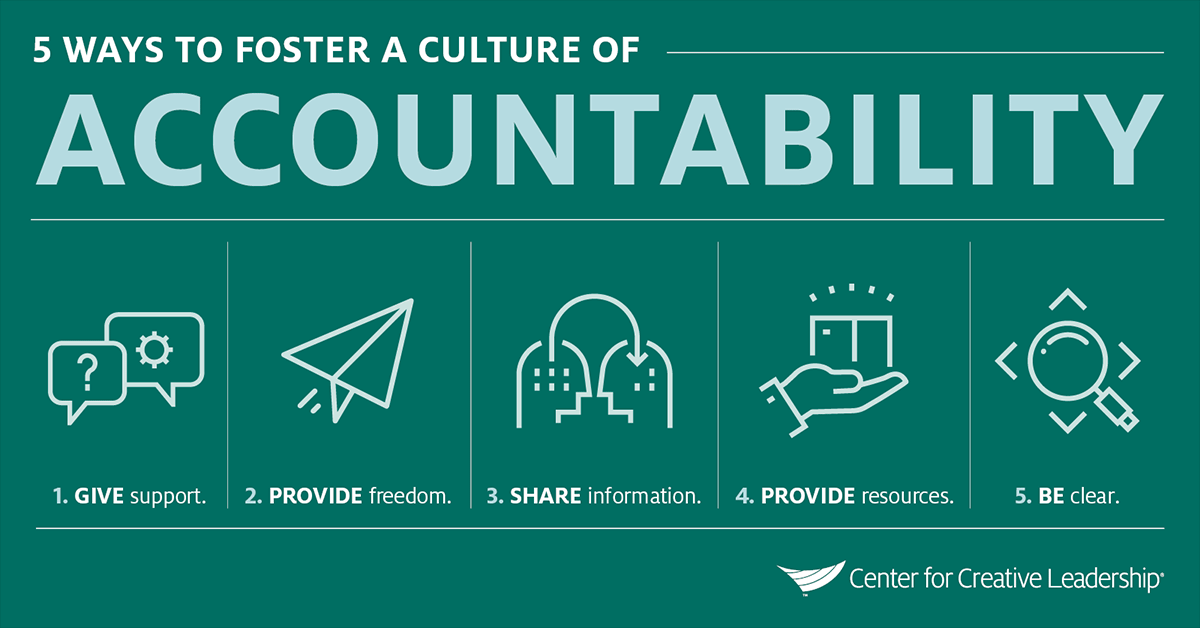
1. Give support.
Employees need to feel supported by senior executives, their direct supervisors, and others on their work teams. Leaders must show compassionate leadership.
2. Provide freedom.
Wherever possible, managers should give their teams the freedom to direct important aspects of the work or to accomplish a goal.
3. Share information.
Employees need access to all information needed to make decisions. Transparency fosters trust.
4. Provide resources.
Red tape, tight control, and too-few resources will undermine a sense of ownership and accountability.
5. Be clear.
Leaders and executives should clearly communicate the vision and goals, responsibilities, and consequences of action or inaction. Who else is involved and what outcomes are expected?
Reduce Fear & Increase Trust for an Accountability Culture
To build accountability and an ownership mentality and culture across the entire organization, leaders need to be able to remove unnecessary fear.
When there’s fear, there’s a lack of psychological safety at work, and people tend to hide, hold back, and do only the minimum. Fear can generate many other secondary emotions, too, such as aggressiveness, anger, micromanaging, defensiveness, lack of engagement, and victim behavior.
When team members feel that it’s unsafe to speak up, thoughtful reservations aren’t shared and new ideas aren’t stress-tested, either. To counteract this fear, managers must work to create more psychological safety and build trust, which is critical to team success.
Once lost, trust takes a long time to rebuild, so the best advice is to equip your leaders to build it consistently over time. Do they know how to show trust through delegating effectively, when to communicate openly and when to keep things in confidence, and the importance of following through on doing what they say they’ll do?
In addition, every manager can help to counteract a culture of fear and build trust and accountability if they:
- Acknowledge and share mistakes. Leaders who are upfront about their own missteps, poor judgment, and errors — as well as the lessons learned — show humility and build trust. Truly accountable leadership is shown when people are willing to own their mistakes, as well as their successes.
- Listen and observe behavior in meetings. Is there a balance of inquiry (asking questions) and advocacy (making statements)? Make sure your organization has not put only the chatterboxes in charge. Leaders may need training to be able to actively listen to understand others.
- Catch employees doing something right. Don’t let your leaders only correct teams when they do something wrong. Make sure they provide positive reinforcement too, and know how to give developmental feedback to foster learning and appropriate risk-taking.
- Stay consistent. Don’t let your leaders fall into the trap of failing to hold others accountable, either. Even letting just one person off the hook who failed to follow through can do a lot of damage. When a manager does that, they send the message to everyone else, why bother?
- Are mindful of the dynamics of fear and trust. Talk to employees and other managers to glean their observations about fear and trust on the team. Ask questions like: “Are people encouraged to innovate, rather than conform?” “Is dissent tolerated?” and “What happens when mistakes occur? How does leadership respond?” For example, leaders may be unintentionally undermining, instead of encouraging, innovation by responding in ways that perpetuate fear.
- Create space for experimenting. If you want more innovation in your organization, work on growing innovative mindsets to create more room for trial-and-error and to help leaders learn to respond to new ideas in more productive ways.
When leaders at your organization model these behaviors, they send a consistent message of accountable leadership and foster a culture of accountability.
Ready to Take the Next Step?
Partner with us to build a culture of accountability by designing a learning journey for the leaders at your organization. Our research-based Accountability Training for Leaders can be used standalone or mixed-and-matched with other proven leadership training topics such as Communication, Conflict Resolution, Delegating Effectively, Feedback That Works, Innovation Leadership, Listening to Understand, Psychological Safety & Trust, and more.