



You know the moment. A team member tells you someone significant in their life just died. You want to support them. And then — for many leaders — comes a quiet panic: What do I do now?
“Bereaved” derives from a word meaning to be robbed. That etymology says something true about what grief feels like, and about why it can’t simply be managed away or worked around. Yet in many organizations, that’s exactly what people are asked to do.
Bereavement is one of the most universal human experiences. Nearly all working adults have experienced it, many more than once. But despite its prevalence, most leaders have received no preparation for supporting grieving employees at work. Good intentions are plentiful. Effective support is not.
Our research reveals a significant gap between what leaders mean to do and what actually helps — and that gap is an opportunity for leadership development. Not to train leaders to be grief counselors. But to equip them to show up — present, honest, and willing to sit with what they can’t fix.
Bereavement at Work: The Toll It Takes
Let’s be clear about what leaders are dealing with.
Bereavement in the workplace is what happens when the experience of loss through death meets the demands of professional life, and it cannot be managed on a schedule or contained within boundaries. Grief doesn’t stay at the door when someone starts work.
We surveyed managers, coworkers, and bereaved employees — a 3-perspective approach that reveals something most bereavement research misses: This isn’t just about the person who experienced the death.
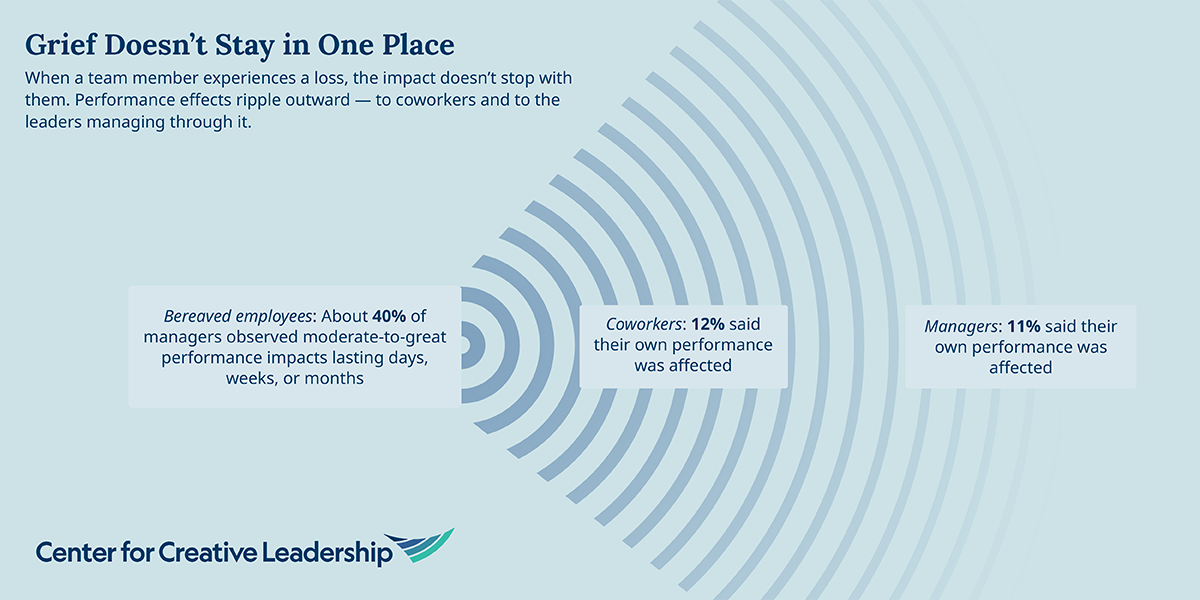
Our data shows that 90% of managers noticed some performance impact in a bereaved employee, and about 40% of managers observed moderate-to-great performance impacts — lasting days or weeks, sometimes months. But consider this, too: 11% of managers said their own performance was affected. Among coworkers, it was 12%.
Bereavement ripples outward, disrupting not just the person at the center of the loss, but the people around them.
The bereavement leave picture compounds this.
Nearly 3 in 4 bereaved employees — 73% — said they didn’t have enough time off from work to grieve. And that’s among those who had access to bereavement leave at all; 28% had none to begin with.
Employees are returning to work before they’re ready, doing the difficult emotional work of grief while simultaneously trying to function professionally. And the emotional weight is only part of it. Bereaved employees may also be supporting grieving family members and managing practical burdens such as funeral arrangements and ongoing estate issues.
These numbers aren’t just productivity metrics. They’re signals of what employees are quietly asked to carry, often without adequate support.
Supporting Grieving Employees: When Good Intentions Fall Short
Most leaders want to do the right thing when a team member is grieving. Unfortunately, wanting to help and knowing how to help aren’t the same thing.
Our research found that while 60% of bereaved employees said their manager treated them with compassion to a great extent, 20% said they received little or no support. That’s 1 in 5 people who went through one of the hardest experiences of their lives and felt their leader wasn’t there.
Before we get to what the research shows about effective support for grieving employees, let’s clarify what leaders are not being asked to do when it comes to bereavement at work: You don’t need the perfect words. You’re not expected to fix the grief (an impossible task) or accelerate someone’s healing (an unreasonable ask). You’re not a therapist.
What the research shows about bereavement in the workplace is much simpler than any of that: Leaders just need to show up, pay attention, offer options, and follow the employee’s lead.
Here’s what our research shows about what leaders get right and wrong.
Subtle Signals, Significant Impact
Managers must pay attention. Leaders often wait for visible signs of distress before responding: a breakdown, a missed deadline, an obvious struggle. But grief at work rarely announces itself that clearly. More often, it shows up in what managers described in our research as quieter, harder-to-read changes.
- “There was a general melancholy about the way she communicated and you could sense the distraction but not to the point where she could not function.”
- “Their inability to concentrate was marked. Appointments were overlooked or forgotten, and some important paperwork was neglected.”
- “I think what was most evident is that my employee just seemed — numb in so many ways. Usually they are super interactive and have a lot of good ideas, but it was like she was dulled.”
These aren’t immediate red flags. They’re subtle signals — and missing them means missing the window to help.
By contrast, here’s what leaders do that makes things worse:
- “I felt like my manager sometimes forgot what I was going through. He would ask why a task took extra time and I wouldn’t really have a response other than that I was doing the best I could.”
- “They did not make any accommodations when I came back. Life just went on as if nothing had happened.”
- “A few days had passed, they went back to normal as if the grief wasn’t there anymore — I thought they wanted me to move on a little too quickly.”
Checking in doesn’t require certainty. It requires noticing.
Small Gestures, Lasting Impressions
When supporting grieving employees, grand gestures matter less than consistent, low-key presence. A signed card. A coffee brought without fanfare. A brief check-in that doesn’t require the employee to perform normalcy.
- “She would surprise me with coffee or just pop in to see how I was doing.”
- “My manager sent a thoughtful card to my home, which made me feel more connected while working remotely.”
Compare those to what employees remembered as unhelpful:
- “I didn’t get a card or anything. She didn’t even bring it up when I got back to work.”
- “My manager knew about my loss but did not acknowledge it. I had mixed feelings about it at the time, but now I am still angry that he never acknowledged it.”
The gesture matters less than the signal it sends: I see you as a person, not just as a role.
One Size Doesn’t Fit Grief
Here’s one of our most important findings: Not everyone wants the same response or needs the same type of support. Some employees need space; others need to talk. Some want to immerse themselves in work; others need reduced expectations. Most leaders, however, apply a one-size-fits-all response to bereavement at work — often defaulting to avoidance or to checking in too frequently — rather than asking.
- “My manager gave me a lot of work as soon as I got back. I think he figured that I would want to just work and get my mind off it. But everybody reacts differently and I wish he would have just asked me how I would want to come back to work.”
- “She let me know she’d work with me however I needed during this time — schedule changes, reduced workload and coverage if I needed to leave or had family obligations.”
- “He was always there to listen if I needed someone to talk to.”
- “She was extremely helpful by giving me the space I needed — didn’t pry into things and let me bring up anything instead of trying to force it out of me.”
The solution is straightforward, and it’s a leadership skill: Ask. “How can I support you right now?” “Would you rather ease back in, or jump in?”
Asking signals that the employee’s experience matters, and it removes the guesswork that leads to mismatched support. Be aware that the employee may not know what they need; give them options, let them settle, and revisit them over time.
When Leaders Get It Right
Bereaved employees remember the leaders who showed up for them. Some of the most powerful responses in our research involved nothing more than flexibility, presence, and protection.
- “My manager was probably the most helpful person I dealt with during this time. She was very forthcoming with expressing that my home life took precedence over my work during the immediate time after my parents’ deaths.”
- “They made it clear to me to take as much time as I needed and didn’t give me any trouble when I had to take days off.”
- “My supervisor was amazing. I’m still forever grateful for his leadership and compassion.”
What did those leaders do? They paid attention and acted on what they noticed. They went to bat for extra time off. They checked in consistently but not excessively. They let employees set the pace. They actively listened. And they simply acknowledged the loss, because our research makes clear that acknowledgment of grief matters more than most leaders realize.
Bereavement at Work Is a Leadership Development Opportunity
Even well-designed leadership development programs have gaps when it comes to unscripted human moments. A team member’s bereavement is that kind of moment — and most leaders arrive at it entirely unprepared.
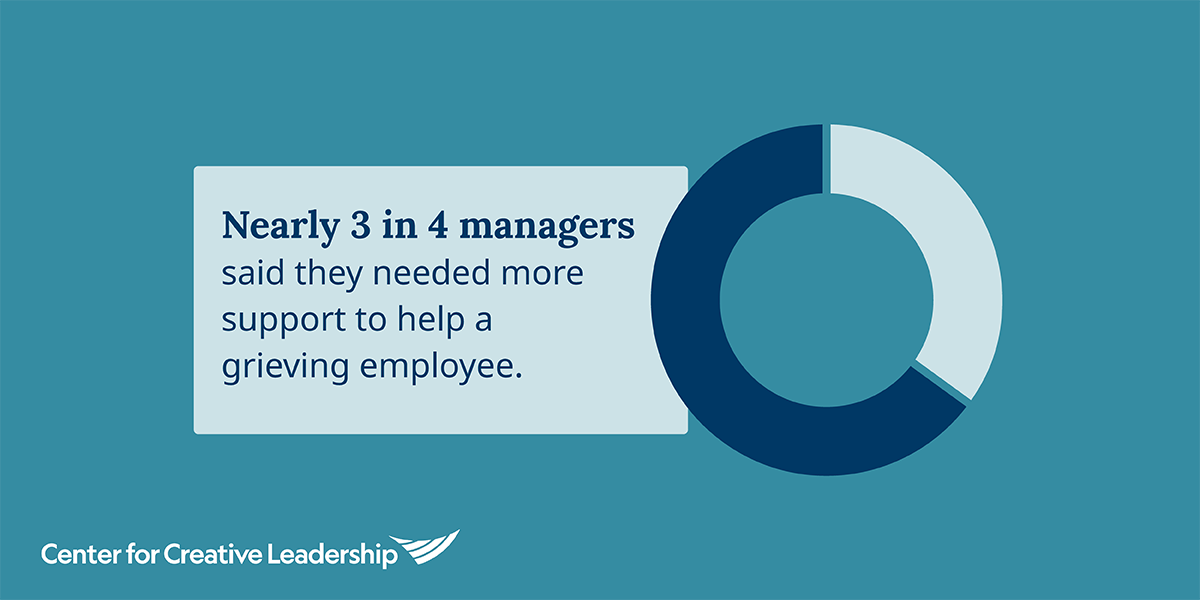
Our research found that 73% of managers said they needed training on how to support a bereaved employee. Nearly 3 in 4 leaders are asking for the basic human skills to show up for their people.
Those skills are not new to leadership development. They are at the heart of it.
The capabilities required to respond well to a grieving employee are the same ones that define great leadership more broadly: emotional intelligence, self-awareness, empathy, the ability to have difficult conversations and coaching presence.
Bereavement in the workplace is a high-stakes test of those skills — one that most leaders have never prepared for.
The answer isn’t a standalone bereavement program. It’s integration. Bereavement in the workplace is a natural context for developing the competencies that already anchor leadership programs. Every conversation about emotional intelligence is, in part, a conversation about how a leader might navigate grief in the workplace and sit with someone who is grieving. Every coaching skills module is preparation for asking, without rushing, “How are you really doing? What else do you need to be supported?”
This isn’t a new layer to add to leadership development. It’s a new lens to apply to what’s already there.
Where Does Our Bereavement at Work Research Lead?
Bereavement will touch every workplace and team. The question is whether a leader will be ready when they face it.
That readiness isn’t about having the perfect words. It’s about having the skills to notice, to ask, and to follow. It’s simply about being, as one of our research participants put it, “human first.”
So consider: Where in your leadership curriculum does a manager learn how to sit with someone else’s pain? Where do your leaders practice saying, I don’t know what to say, but I’m here? Sitting with those questions — and developing leaders who show up for people in the ways they need — is work worth doing.
Ready to Take the Next Step?
Our bereavement at work research is ongoing. Stay updated on our latest insights by signing up for our newsletters.