

Best Practices to Increase Impact of Self-Paced Online Leadership Training
Imagine a leadership course that seamlessly fits into your schedule, travels with you across time zones, and still feels personal and engaging. This is the promise of an effective self-paced online course.
The key word here is effective — because many virtual learning experiences hold great promise but ultimately fall flat.
Asynchronous, self-paced online leadership development courses are on the rise in many L&D budgets, offering professionals the ability to grow their leadership capacity on their own time, from anywhere.
Yet self-paced online leadership learning poses a course design challenge: How do we deliver a deeply human and effective leadership learning experience without the benefits of live interaction?
Based on our digital learning research and implementation, we examined what drives success in self-paced virtual learning experiences to help organizations design solutions that maximize learner engagement, skill application, and impact. Drawing from participant data, course outcomes, and practitioner experience, we identified elements that most significantly improve participants’ experience and their ability to apply learning at work.
Through developing thousands of leaders in entirely online leadership training courses, we’ve discovered that the most effective asynchronous virtual courses are personalized, intuitive, relevant, and caring.
While digital courses may achieve success in different ways, our research reveals 3 critical course design elements that consistently elevate the efficacy and impact of asynchronous online learning:
- The learning platform is user-friendly and supports positive behavior change.
- Operational support is clear and proactive.
- A skilled moderator fosters engagement and meaning-making.
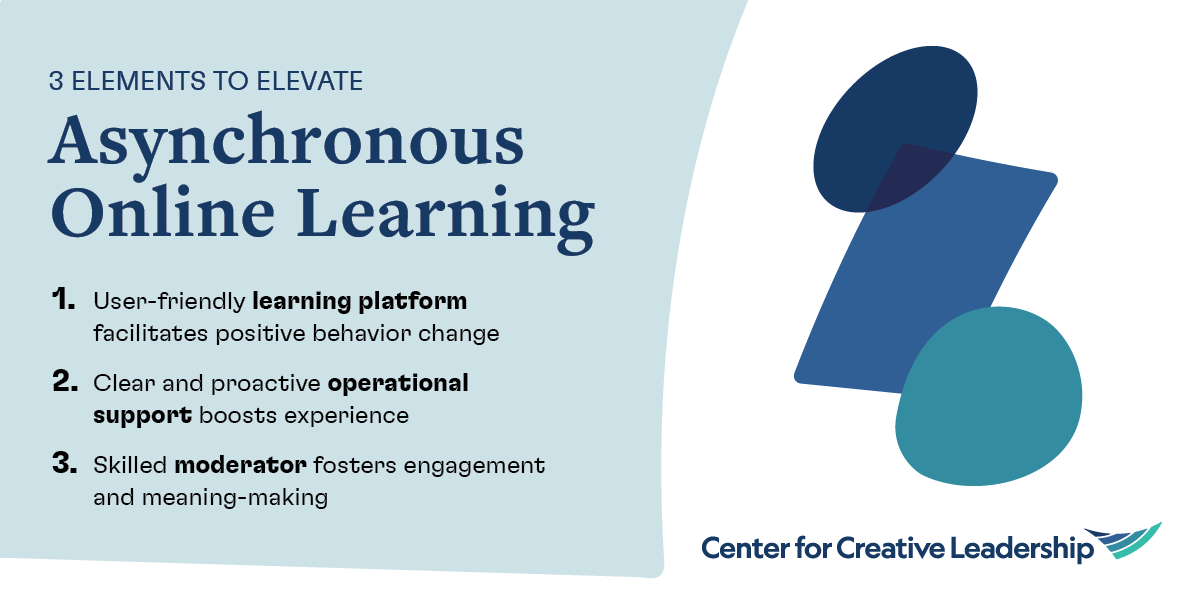
3 Elements To Elevate Asynchronous Online Learning
1. The Self-Paced Virtual Learning Platform: Getting the Foundations Right
Effective online leadership course design starts with the learning platform. More than a delivery vehicle, it’s the digital environment where participants encounter content, interact with peers, reflect, and take action. The platform is the virtual equivalent of the classroom.
Just as a classroom experience suffers when slides aren’t visible or classmates can’t be heard, the same problems arise online when navigating the platform is difficult, technical issues occur, or support is unclear.
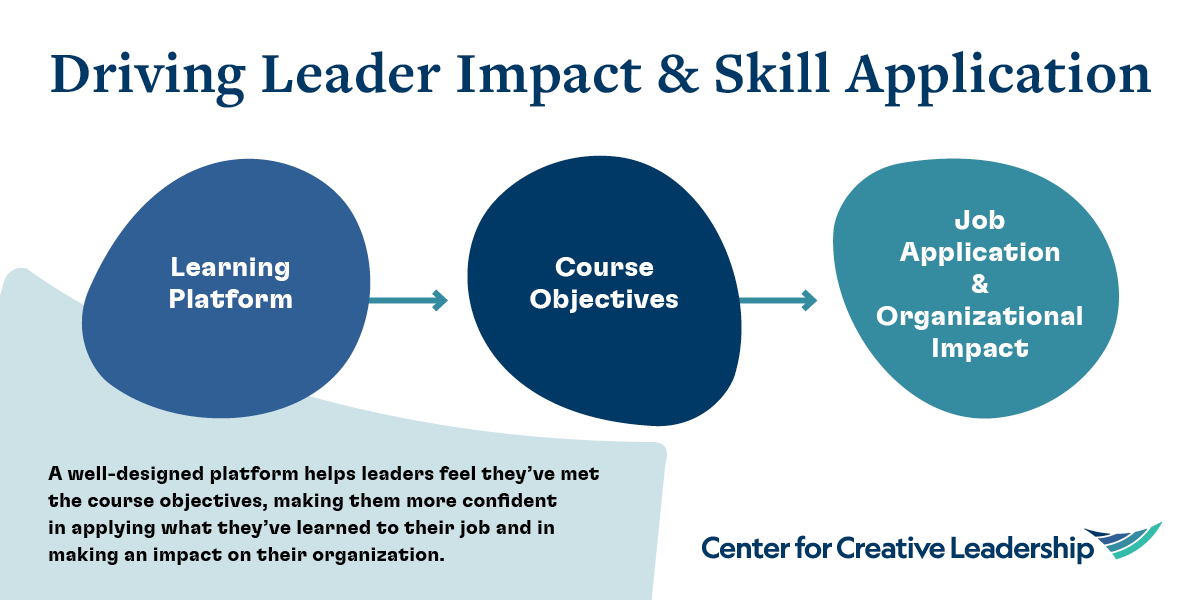
The data shows that when participants believe the learning platform is easy to navigate, they’re significantly more likely to report that the course is meeting its learning objectives. This finding aligns with cognitive load theory, which explains how our brains process and handle information. When a platform is difficult to navigate, it creates extraneous cognitive load — mental effort spent on irrelevant tasks like figuring out where to click or how to access content in a platform. This leaves less mental capacity available for actual learning.
This insight suggests that participants who find the virtual platform intuitive and smooth invest less cognitive energy on navigation and technical hurdles and more on learning itself. By reducing extraneous cognitive load, learners can dedicate their full mental capacity to processing new leadership concepts and connecting them to their work context. The learning platform that eases cognitive load is critical for increasing their likelihood of meeting course objectives, which in turn drives stronger self-reported application on the job and greater organizational impact.
Additionally, our research found that including even minimal social elements in online leadership course design — such as grouping participants or enabling peer check-ins — is related to greater persistence in virtual programs by fostering accountability and reducing isolation.
What makes for a good learning platform? We’ve found that an effective learning platform requires:
- Ease of navigation: The interface must be intuitive and uncluttered, supporting learners to progress without confusion.
- Behavioral guidance: Prompts, notifications, and layout should gently cue participants toward productive engagement, such as timely check-ins and visible deadlines.
- Multiple modes of engagement: Videos, discussion boards, quizzes, messaging, and downloadable resources cater to diverse learning preferences.
- Features that build ownership: Tools like a highlighter for takeaways or a point system that rewards engagement help learners track their growth and see their progress.
- Confidentiality and psychological safety: Built-in features that preserve privacy settings and foster respectful peer exchange are essential in leadership learning.
- Social learning integration: Design elements should actively encourage interaction with other participants through features such as replies, likes, shared projects, and discussion prompts.
Like any technology, a learning platform’s development is never complete — technological advances must continue to serve the learner and the stakeholders in the learner’s success.
2. Operational Support: Setting Participants Up for Success
Online learner engagement starts with support. In the absence of live facilitators, operational support provides the clarity, responsiveness, and structure that set the tone for the entire self-paced learning experience. It’s not just logistics — it’s the digital equivalent of hospitality.
The data shows that strong operational support is crucial to the participant experience. When participants report receiving timely, clear, and supportive communication — and experienced, prompt, and helpful responses to their questions or concerns — they report higher levels of satisfaction and greater likelihood to recommend the course.
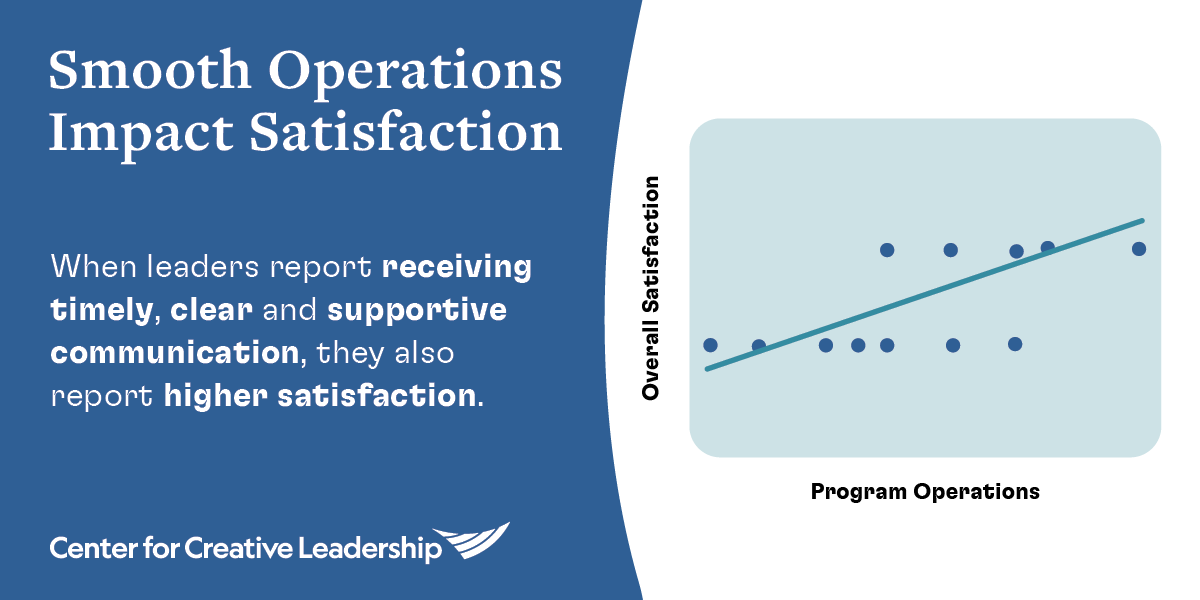
What does strong operational support look like? Strong operational support combines logistical excellence with human-centered communication, ensuring participants feel welcomed, informed, guided, and supported throughout their experience. Done well, it fosters clarity, reduces anxiety, encourages commitment, and reinforces the participant’s identity as an active, capable learner.
Operational support should unfold across 3 phases to ensure learning transfer:
- Prepare phase: Before the course begins, setting clear expectations and building momentum
- Engage phase: During the course, providing responsive and proactive communication
- Apply phase: After the course ends, offering closure and messaging focused on how to put learning into practice
Based on our experience, the following best practices for self-paced online leadership development courses help in each phase:
Preparation Phase (Before the Learning Starts):
- Clear and timely onboarding messages
- Participant selection guidance to ensure course fit
- Orientation sessions (live or asynchronous) to preview platform, expectations, and time commitment
- Optional tools like calendar blocks
- Messages that explicitly position participants as “active learners”
- Engagement with primary stakeholders in the participant’s organization — including their managers, L&D / HR leaders, and senior management sponsors
- Early connection between participants and course / engagement managers
Engagement Phase (During the Course):
- Proactive check-ins via email or platform messaging
- Prompts that help with time management, pacing, and peer interaction
- Personalized outreach to participants falling behind
- A clear presence of a responsive support team for tech and content questions
- Cohort-level updates to maintain momentum and a shared learning experience
Application Phase (After Course Completion):
- Encouragement to reflect on impact and take next steps
- Follow-up nudges to translate learning into action
- Invitations to post-program learning opportunities
- A summary of the experience to stakeholders who are responsible for learning and development in the organization
There are many touchpoints and stakeholders involved in each of the 3 phases:
| Phase | Participant Touchpoints | Stakeholders |
|---|---|---|
| Prepare | Enrollment guidance, orientation, manager kickoff | Operations, Implementation Manager |
| Engage | Platform use, moderator connection, weekly check-ins | Participants, Moderators |
| Apply | Project submission, reflection prompt, follow-up resources | Participants, Support Team |
3. Moderation: Bringing the Human Touch to Self-Paced Learning
Even in asynchronous online learning, participants don’t want to feel like they’re learning alone. Moderators can’t replicate the immediacy of a live facilitator — but they can cultivate a sense of presence, support, and relevance.
The data shows that the quality of the moderator matters. When participants report that their moderator greatly enhanced their learning experience, helped them think deeper about their challenges, and stimulated engaging class discussions, they report greater satisfaction and likelihood to recommend the course. They’re also more likely to feel the course is meeting its objectives, which subsequently leads them to believe they’re better equipped to apply what they’re learning in their job.
What’s the role of a skilled moderator?
- Build psychological safety and trust through personalized outreach.
- Spark peer-to-peer engagement to build social learning.
- Monitor and encourage cohort momentum.
- Provide guidance on course progress and deadlines.
- Offer targeted feedback on reflective assignments.
- Invite deeper thinking through discussion replies or nudges.
- Show up as a warm, responsive, credible presence — even asynchronously.
What skills and practices make for a good moderator?
- Curate meaningful replies in discussions that provoke reflection without dominating the space.
- Use thoughtful, brief messages to connect individually with participants who seem disengaged.
- Offer timely, constructive feedback.
- Use progression data to strategically time outreach and nudges.
- Balance presence and boundaries: Participants should feel seen, but not micromanaged.
Beyond Design: Supporting Learner Motivation in Self-Paced Online Leadership Courses
Design matters — but it’s not the whole story. Participants must also be motivated to engage for a digital course to deliver on its potential. Our research highlights the pivotal role that motivation plays in shaping learner persistence and success.
We found that participants who entered a self-paced online course with higher motivation completed more lessons than those who started with lower motivation. This reinforces what many practitioners intuitively know: When learners believe the experience is relevant, achievable, and worth their time, they’re more likely to stick with it.
Importantly, the research also showed that perceived support from managers and organizations — before the program even begins — are strongly related to motivation and indirectly related to persistence. When leaders feel that their development is valued and supported, they’re more likely to approach learning with energy and commitment.
Organizations play a powerful role by creating a learning culture that encourages development broadly, while managers can make a difference by signaling boss support and helping employees carve out time, set expectations, and feel confident about engaging in learning.
What are practical ways to increase learner motivation?
- Encourage managers to send personalized kickoff messages that reinforce the value of development and signal organizational support
- Help learners connect the course to their personal and professional goals to increase perceived relevance and utility
- Offer protected time and clear role expectations so learners can prioritize the experience without competing demands
- Use brief pre-course surveys or check-ins to identify motivational barriers and tailor outreach accordingly
- Frame development as a shared priority across the organization to normalize participation and boost perceived value
Elevating Asynchronous Online Learning Design
Self-paced online leadership development isn’t a trend — it’s an essential part of the modern learning ecosystem. Effectiveness in this format doesn’t happen by accident.
Our research and experience point to a core insight: When digital programs are grounded in intentional design — technically, operationally, and relationally — they can feel just as human and impactful as their in-person counterparts.
When strong design is paired with strategies that boost learner motivation from the start, that increases the likelihood of meaningful engagement and program completion.
By investing in the right platform design, proactive support systems, and thoughtful moderation, you can optimize your digital learning strategy and ensure your online leadership courses are designed to be both scalable and deeply personal.
In summary, here are key elements for effective self-paced digital courses:
| Core Element | Key Practices | Outcomes Supported |
|---|---|---|
| Learning Platform | Clear UI, behavioral nudges, flexible modalities, peer exchange | Greater focus on learning, higher reported ability to apply |
| Operational Support | Onboarding, proactive outreach, participant guidance, timeline clarity | Greater satisfaction and likelihood to recommend the course |
| Moderator Presence | Feedback, cohort messaging, engagement tracking, social learning prompts | Greater alignment to course goals |
Ready to Take the Next Step?
See how our asynchronous online training course frontline leaders equips new and emerging leaders with the skillsets and mindsets to thrive. For organizations seeking scale, our CCL Passport™ provides enterprise-wide access to this program and our full portfolio of digital leadership development tools. Whether you’re supporting a single manager or an entire leadership pipeline, our digital solutions deliver impact at every level.