Why Leadership Energy Drives Organizational Performance
The most resilient leaders still depend on the organization around them. See how leadership energy is already impacting performance in your organization, and where it belongs in how you develop leaders.
The Scenario
Imagine this…
A VP notices her best director has gone quiet in meetings, still capable but visibly diminished. Around the same time, a handoff between teams that used to run smoothly starts creating friction: there’s missed alignment and a sense that neither group trusts the other. By the end of the quarter, several departments report missed targets, and each one is certain their situation had nothing to do with the others.
These appear to be separate issues, with unique fixes: a coaching conversation, a boundary-spanning exercise, and a performance audit. But what if these challenges share the same origin, showing up in different places?
Leadership energy.
Energy is a misunderstood and under-measured driver of performance. Seen clearly, it’s something leaders can learn to cultivate in themselves and help others do the same. Seen at scale, it’s a reason for organizations to ensure their systems sustain energy instead of working against it.
Leadership energy determines whether an organization’s effort builds momentum or breaks down. It’s the underlying capacity that makes employee motivation, morale, and organizational performance possible, and a clear signal of where performance is headed before results fully show it.
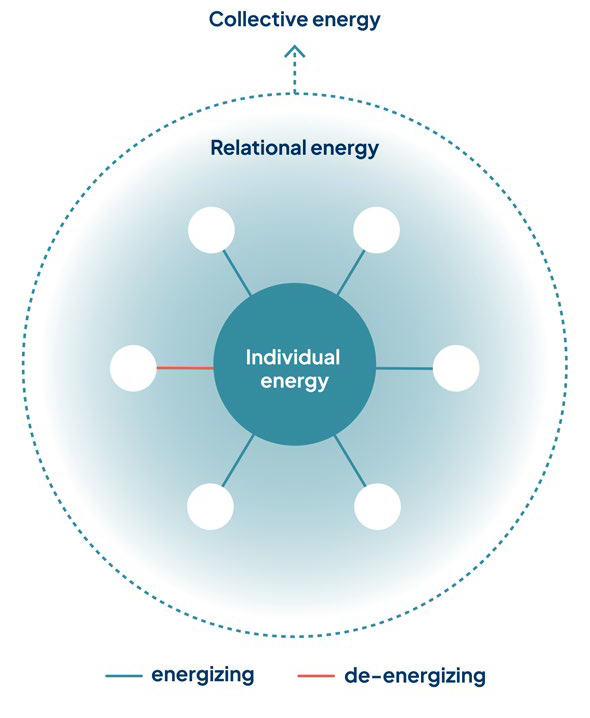
To understand leadership energy more clearly, think about how energy at work operates on 3 levels: the energy a leader brings individually, the energy created between people, and the collective energy that forms when those exchanges compound across the entire organization.
Individual: What a leader carries into every interaction.
Relational: What’s created between people.
Collective: What emerges when energy multiplies across every exchange.
Energy Isn’t Only a Leader’s Responsibility
Managing energy well is a leadership capability, and it starts with a leader cultivating self-awareness and habits. Understanding the importance of organizational energy also means recognizing something outside any one leader’s control: a system built to support what they’re trying to do.
When individual leadership development and a healthy leadership ecosystem grow together, the energy of each produces stronger performance.
Take for example a director who learns through 360 feedback that his team’s meetings are draining, not because of the number but because every meeting defaults to open-ended discussion with no clear outcome. He restructures how his meetings run, and his team responds positively. But the meetings coming from other departments still run the old way, and 6 months later, his team is just as de-energized.
He did everything right, and his team was initially better for it. But the organization kept draining the energy he tried to protect. That’s the cost when organizations treat energy as a personal responsibility rather than a shared one: Even the right fix can’t outlast a system working against it.
What Holds a Leader Up
The Research
The Outsized Impact of 1 De-Energizing Relationship
Not every relationship carries the same weight. A de-energizing one costs far more than it may seem to, and it’s often one-sided: only one person in the relationship experiences it as draining.
Our relational energy research, based on assessment data from 600+ leadership teams, measured how much weight energy carries. Team leaders and members rated how interactions with each person typically affected their energy level.
How de-energizing relationships affect teams
The good news: Only 9% of the relationships were de-energizing.
Illustration: a grid of 100 circles. 9 are filled, representing de-energizing relationships; 91 are outlined.
But those negative ties hit harder. Removing 1 de-energizing relationship has the same impact on team effectiveness as adding 4 energizing ones.
Illustration: a level balance scale. 1 filled circle on one side balances 4 outlined circles on the other.
When the negative relationship involves the team’s leader, the impact triples.
Illustration: the filled circle grows to 3 times its size and the scale tips toward it, outweighing the 4 outlined circles.
De-energizing relationships are rarely mutual. In 87%, only 1 person experienced the relationship as draining.
Illustration: two circles, one purple and one white, each holding 5 battery-style bars. As the circles move closer together, the purple circle stays fully charged while the white circle drains from 5 bars to 2, showing the relationship is draining for only one person.
The imbalance of negative energy doesn’t stay contained to how 2 people get along. It shapes outcomes that determine how a team can function.
Take psychological safety, a strong predictor of team performance. One de-energizing relationship erodes it more than an energizing relationship helps it. Neutralizing the impact of one de-energizing relationship on psychological safety takes 4 strongly energizing ones, and that only brings the team back to neutral.
Multiply that math across every team in an organization: A handful of unaddressed negative relationships can cap how far organizational energy, and performance, can go.
Hear more about what these insights mean, directly from one of the researchers behind them.
The Challenges
Leadership Energy at Work: The Origin Behind Familiar Challenges
You’ve just seen what one relationship can do to a team. But that’s only one way negative energy shows up in an organization. Energy also drives some of the most familiar challenges leadership development seeks to address.
Burnout spreads wide. When an exhausted leader has less energy to give the people around them, that fatigue moves through every interaction, eventually spanning levels and departments.
AI is accelerating work. The energy leaders need for independent judgment erodes underneath the speed, and trust breaks down when no one can tell if a decision reflects collaborative human thinking or an AI answer.
Leadership readiness is weakening. Energy is unevenly distributed, overloading some teams while others go untapped, wearing down the entire talent pipeline.
Complexity isn’t letting up. Energy stays under constant pressure; it’s spent on reactive alert instead of the performance it should be building.
Each shows up differently, but the mechanism is the same: leader energy that isn’t being preserved, renewed, or guided well. That’s what makes leadership energy a lens worth using: It helps you address several top organizational challenges at once.
The opportunity is finding where a leader’s energy and the systems around them meet, then choosing the right level of action: individual, relational, or collective.
Get the Report
Energy Is a Leading Indicator
Because individual, relational, and collective energy compound into each other, a shift at one shows up before it becomes a visible problem at the next. That makes leadership energy even more valuable: It signals where performance is headed before it appears in an engagement score or an exit interview.
The signal itself tells you what to change, and where. Read it early enough, and you can shift a behavior before it becomes a habit, or a habit shapes a culture.
Once you know where energy is generated, shared, or lost, you can build development that addresses it directly, for individual leaders, for the relationships between them, and for the leadership ecosystem that either sustains that energy or works against it.
Our Energy Equation gives you the language to diagnose where that’s happening in your organization. The full report goes further, laying out the research behind it and the specific development actions that address energy at its source.
Related Webinars: Hear From Our Experts
Mon., Nov. 23, 2026 · 2:00 pm EST / 8:00 pm CET
How Leader Resilience Impacts Energy Dynamics at Work
Frequently Asked Questions About Leadership Energy
Leadership energy is the individual, relational, and collective force that determines whether an organization’s effort builds momentum or breaks down. Without it, employee motivation and morale have less to draw from. Energy shows up in a leader’s energy, in the energy created between people, and in the collective energy that emerges across an entire organization. Understanding leader energy and organizational energy together is what makes our energy equation a useful lens for diagnosing where energy is compounding, where it’s leaking, and where to act first.
Leadership energy functions as a leading indicator, signaling where performance is headed before it shows up in an engagement score or an exit interview. The importance of organizational energy lies in what it predicts: whether people bring focus, creativity, and commitment to their work, or become depleted and disengaged. Energy at work is a wellbeing concern, and it’s a measurable driver of team outcomes such as psychological safety.
Leadership energy affects organizational performance by shaping whether effort compounds into results or gets lost along the way. When leaders manage their energy and organizations build the systems that sustain it, teams show stronger psychological safety, more resilient succession pipelines, and steadier execution. When energy is depleted, unevenly distributed, or turns negative, the opposite happens: burnout spreads, talent pipelines weaken, and momentum stalls.
Our relational energy research measures this: Across more than 600 leadership teams, a single de-energizing relationship offsets the effect of 4 energizing ones, and that effect triples when it comes from a leader. Part of what makes de-energizing ties so damaging is that they’re often one-sided: in 87% of cases, only one person in the relationship experienced it as draining. Without that mutual awareness, there’s little natural prompt to address it, so the imbalance can fester and grow rather than surface and resolve.
Organizations can address energy through leadership development at the individual, relational, and collective level, since the 3 are connected. That includes building individual capability through resilience-building training, which helps leaders recharge and sustain performance without burning out, alongside organizational-level work: examining culture, workload distribution, and the systems that either sustain energy or work against it. We partner with organizations to diagnose where energy is breaking down and build development that addresses it at its source.
How Leadership Energy Affects Individual & Organizational Performance
Share a few details to download the full report. You'll discover more about how energy is a leading indicator of performance.
Your report is ready.
Your download should begin automatically. If it doesn’t start, check the email we just sent you.





 Peter Ronayne, PhD
Senior Faculty
 Paige Graham, PhD
Global Portfolio Manager, Consultative Solutions