
You invest in leadership development because you need leaders to change how they work. But here’s the challenge: many leaders struggle to turn learning into action. They often can’t clearly articulate the critical leadership behaviors they need to develop or how those behaviors connect to real work challenges.
When asked to describe a critical leadership challenge, they show up with technical or task-focused problems (“We need better sales forecasting”) instead of focusing on what they need to do differently as a leader (“I need to build alignment across functions that don’t trust each other”). They frame organizational issues, not personal growth opportunities. And when the application point is unclear, learning transfer suffers.
Our research suggests AI can help, not by replacing human coaching, but by doing what AI does best: providing structured, scalable support that helps leaders think more clearly and lays the foundation for deeper understanding and conversations.
The Challenge: Leaders Can’t Always Define a Key Leadership Challenge
Leadership development programs hinge on whether participants can identify and articulate a real, work-related leadership challenge (which we call a Key Leadership Challenge, or KLC). This is the anchor that helps translate leadership learning into workplace impact.
Within our leadership programs, we ask learners to articulate a KLC before or during the experience. About 1 in 4 participants typically frame their KLC as a technical or organizational problem instead of a personal growth opportunity. A technical frame points to external fixes, while a growth frame sees the leader’s behavior as the key to applying what they’ve learned. Without the right framing, the KLC falls short in learning transfer.
Our Research: What Happens When AI Serves as a Thinking Companion?
Our randomized controlled trial tested whether an AI thinking companion could help leaders articulate stronger Key Leadership Challenge statements by providing scalable support, which allows more time for reflection and clarification.
The trial focused on leaders in the same development program, randomized into 2 cohorts:
- Traditional control cohort: Given a single open-ended prompt to define their leadership challenge
- AI-supported cohort: Guided through a structured dialogue with an AI chat tool
The AI chatbot didn’t write their challenge for them. It posed relevant questions:
- What’s the challenge?
- Why is it hard?
- Who’s involved?
- What does success look like?
- Who benefits?
The AI chat tool paraphrased answers, asked follow-up questions, and helped leaders refine their thinking until the challenge was clear, complete, and focused on personal leadership growth.
The Result: 100% of Leaders Who Completed the AI Chat Activity Articulated Adequate or High-Quality Challenges
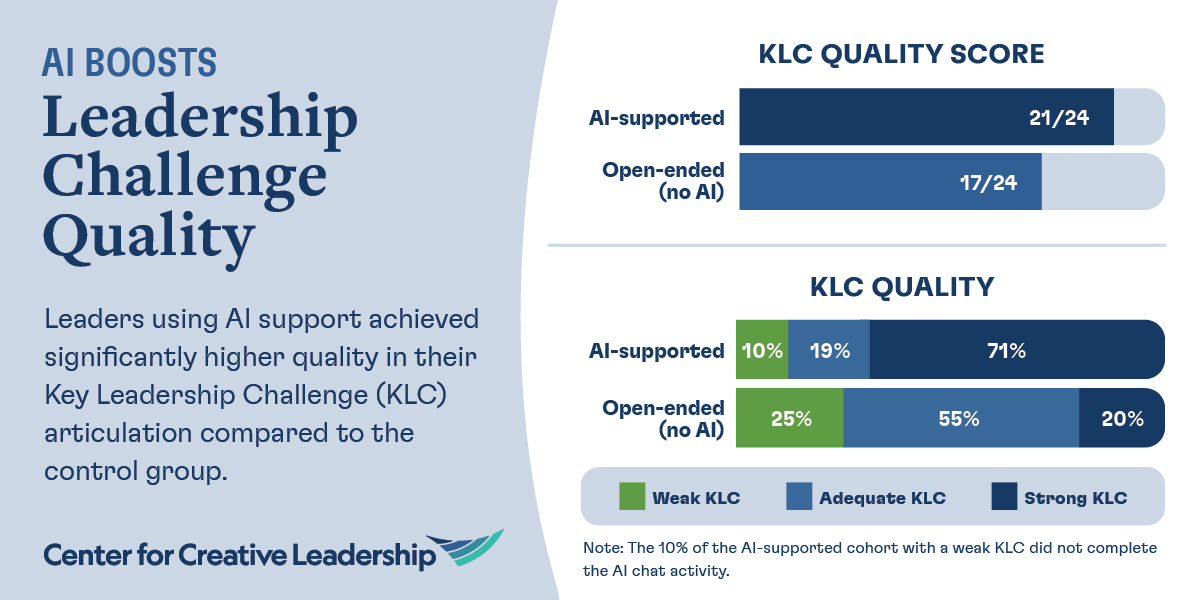
Introducing an AI-supported thinking companion greatly improved Key Leadership Challenge quality, measured by relevance and importance; engagement with others; complexity; growth orientation; clarity; and completeness for participants who completed the AI chat activity. Overall, compared to the control group, leaders using the AI tool:
- Produced higher quality KLCs (average score of 21/24 vs. 17/24)
- Articulated stronger KLCs (71% vs. 20%)
- Were more likely to have growth-oriented, leadership-focused KLCs (90% vs. 55%)
KLC quality improved not just in scores but in substance, shifting from narrow technical challenges to adaptive, influence-driven, systemic leadership work. The largest gains in completeness and clarity came from the AI’s structured dialogue addressing each KLC element.
Here’s how the AI thinking partner helped:
1. Structured Reflection Slowed Leaders Down
The traditional open-ended prompt invited shortcuts: leaders wrote 1 or 2 sentences with missing elements and moved on. The AI dialogue forced them to pause and think through each element. By slowing the process, the AI increased completeness and led to more actionable KLCs.
2. Reframing Prompts Moved Leaders From Symptoms to Root Causes
When leaders began with a narrowly defined issue, the AI prompted them to consider broader, systemic factors. This reframing shifted the challenge from a tactical fix to a strategic opportunity, enhancing relevance, clarifying stakeholder roles, and strengthening the leadership‑change focus of the KLC.
3. Growth-Oriented Questions Linked Challenges to Personal Development
One of the most powerful AI prompts was: “What about this challenge will require you to grow or adapt as a leader?” This nudge helped leaders connect the organizational problem to their own leadership capacity, shifting the frame from “the organization needs to change” to “I need to lead differently.” This reframing made the KLC more development-focused and set the stage for richer follow-up conversations.
4. Immediate Paraphrasing Created a Feedback Loop
After each set of responses, the AI paraphrased and summarized. This gave leaders a mirror in which they could see whether their thinking was clear or muddled. By doing so, leaders reflected on their thinking before involving anyone else.
Why This Research Matters for Your Organization
Learning transfer can be difficult. Programs might feel great in the moment, but behavior change back at work may be inconsistent. Theoretically, when leaders start with a clear, leadership-focused challenge grounded in real work, the challenge becomes the through-line connecting content, coaching, and action planning, making leaders more likely to apply what they learn. AI scaffolding enhances the learning transfer process by helping leaders articulate clearer KLCs. Having clearer KLCs allows for:
- Higher engagement in peer learning. When leaders bring clear, well-articulated challenges to peer consultations, the quality of feedback improves.
- Better coaching conversations (if applicable). Coaches can spend less time helping leaders figure out what they’re working on and more time helping them navigate how to bring their leadership development learning to life when back at their organizations. The depth of coaching increases because the foundation is stronger.
Our research on AI-chat tools suggests that they can meaningfully enhance the leadership learning experience. This aligns with our commitment to human and AI partnerships: using technology to amplify, not substitute, the human elements of leadership development.
Ready to Take the Next Step?
Explore our AI-powered chats in our online programs for first-level managers, Frontline Leader Impact and CCL Boost™, or use them in your own custom leadership programs. They help leaders articulate challenges, reframe perspectives, and accelerate growth. Start today and see how AI can boost leadership development in your organization.